Introduction
There are lies, damned lies and statistics… but credible national information on firearms licensing is vital for the shooting community.
This is especially important when:
- Licensing Fees have doubled – What are we getting for the extra money?
- Backlogs are widespread and these delays threaten the future of the sport.
- Numbers refused / revoked are at the highest levels since records began.
Previously, I have been critical on the available information. The first article in this series can be found via this link – https://firearmslicensing.net/behind-the-numbers/
Following this I wrote to the National Police Chief’s Council lead raising my concerns and received this reply on 17th August 2025:
what we will be doing with the recent end of July data capture to ensure it can be interpreted by anyone wanting to understand their local firearms licensing performance and compare this nationally.
This updated information can be found via these links:
In this article, which will be regularly updated, I walk you through my assessment of the figures provided step-by-step. If numbers aren’t for you then skip to “The End Result” of each section to see the final conclusions.
If viewing on a mobile device please note – All images will be available via the gallery at the bottom of this article which will make them easier to read.
Please note– I am not a statistician and errors can be made. The following is presented in good faith and any required corrections that are highlighted will be addressed and apologies offered if necessary.
Chapter 1 – Complete in 4 months
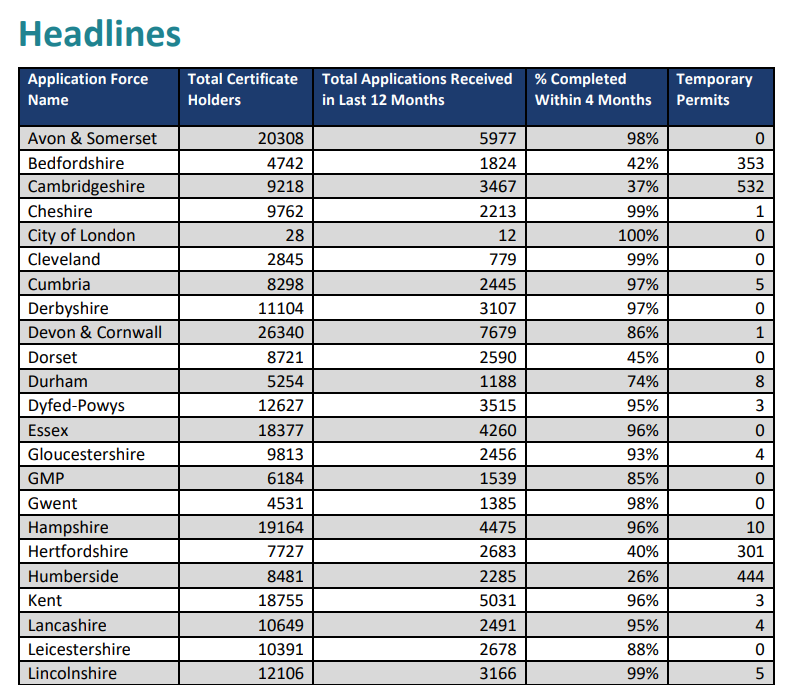
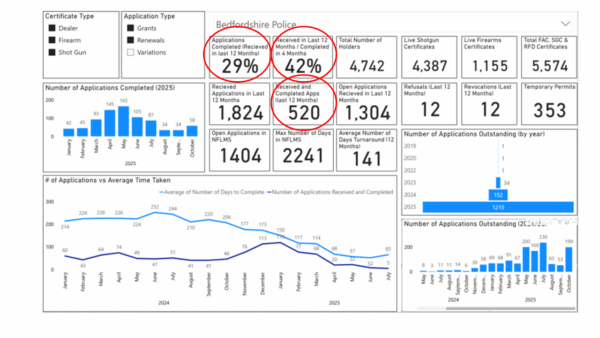
The “Headlines” at the start of the documents look like this.
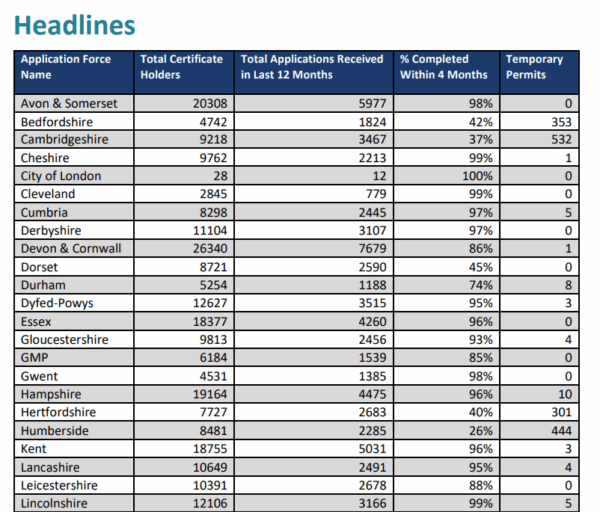
It’s usual to present key information at the start of a document (not everyone likes numbers as much as I do!) but are they the right numbers?
It’s very natural to read numbers presented next to each other as being linked together. The column “Total Applications Received in last 12 months” and “% Completed Within 4 Months” are right next to each other.
So looking at Bedfordshire we see 1,824 application have been received and 42% completed within 4 months but what does that tell us? Not what we first think…
The Guidance Notes (See below) make it clear that the “completed in 4 months” percentage is not a percentage of all the applications received but rather a percentage of those received and completed within 12 months.

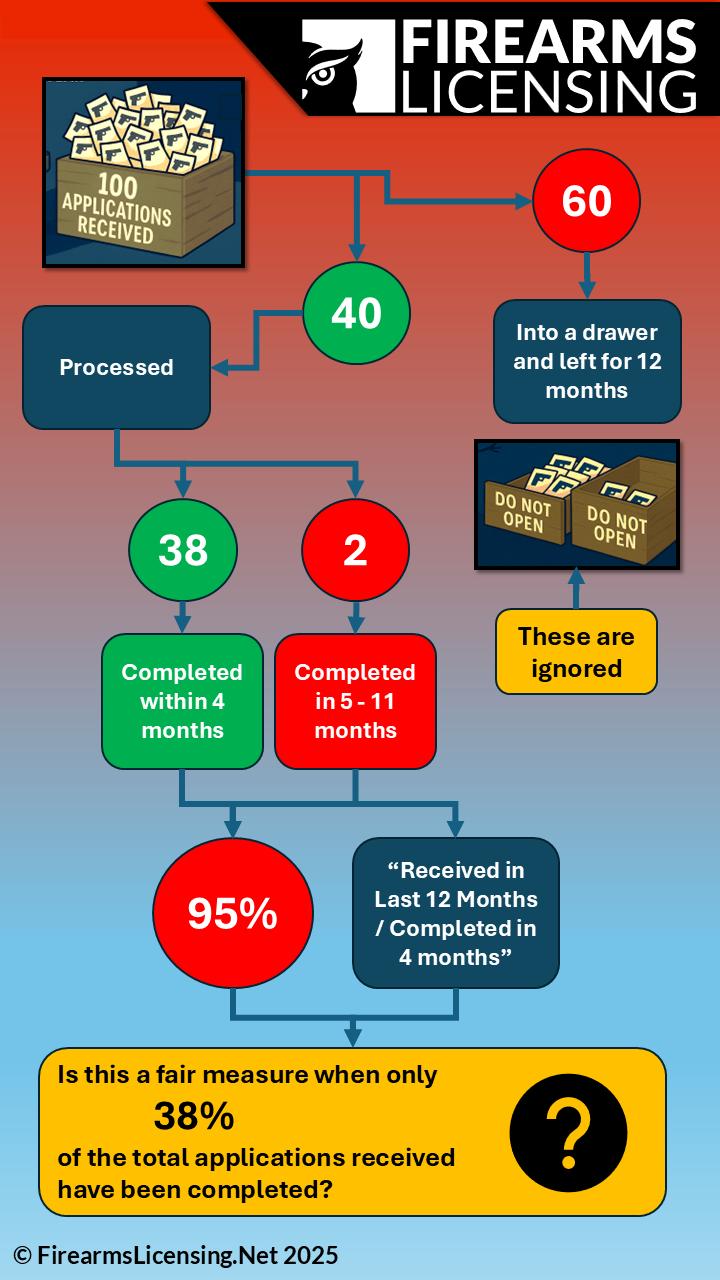
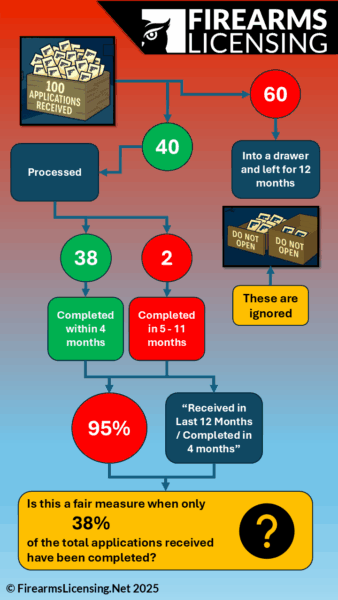
It’s not easy to understand why these are presented in this was but it can seriously distort your perception of what is going on. To try and explain the risks with this information as clearly as possible I have created this fictitious example.
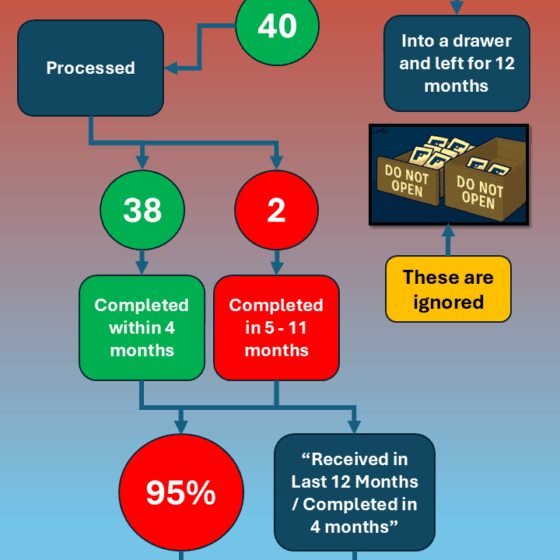
I receive 100 applications and put 60 into a drawer – I do nothing with these. The remaining 40 I work on and complete 38 within 4 months. The remaining 2 take slightly longer. Of those 40 applications I have processed 95% (38/40 = 95%).
But, in reality only 38% of all applications received have been completed within 4 months.
1 – The Detail
Going back to Bedfordshire this means that if we want to know how many of the applications were completed in 4 months as a percentage of all applications received we need to look closer.
- 1,824 applications received in the last 12 months. 520 of those were completed.
- Of those 520 completed 42% were completed within 4 months = 218
- 218 is 12% of 1,824
1 – The End Result
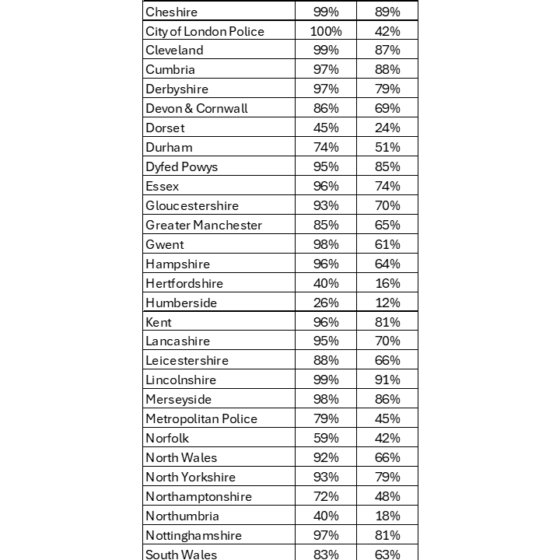
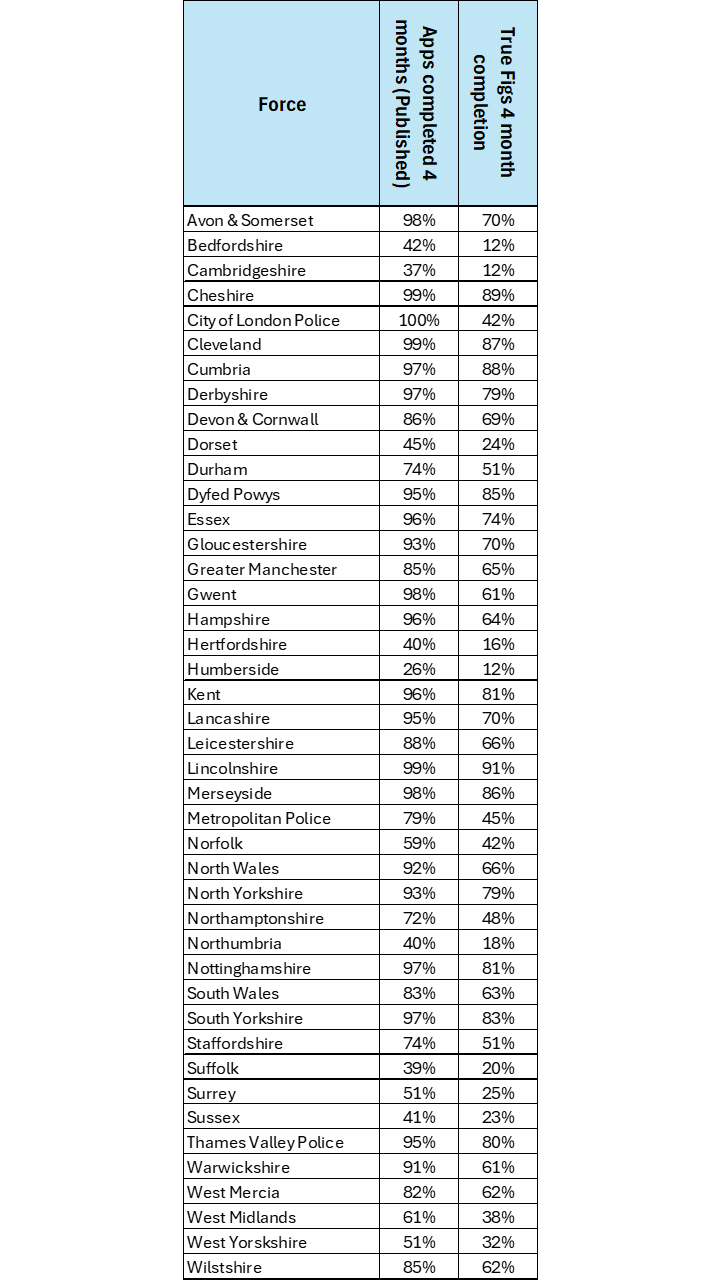
If we follow this methodology then the results look very different and arguably give a much more accurate idea of performance in this area.
If the image does not display well on the screen go down to the bottom of the article and view it via the gallery.
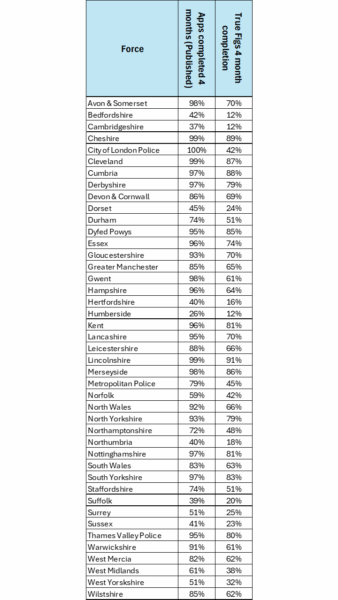
Across the majority of police forces we now see a very different picture emerging. Taking Gwent as an example we go from 98% (which seems very impressive) to 61%.
Why 4 months?- There is actually some science and background as to why this is important. The Firearms Act 1968 gives those applications received more than 8 weeks before expiry an automatic extension of a further 8 weeks. So 16 weeks in total (4 months ish) is the expected processing time contained in the primary source of law in this area.
Chapter 2 – Productivity
Firearms licensing is a complex system with many variables. The detailed information presented on each individual force is useful but going back to the National Police Chief’s Council (NPCC) earlier comment on what their ambition was for these statistics:
ensure it can be interpreted by anyone wanting to understand their local firearms licensing performance and compare this nationally.
This is what the detailed force data looks like. Does it achieve their aim and allow anyone to understand and compare?

2 – The Detail
The balance between making something simple enough to be useful and acknowledging the complexities is difficult and no single measure will ever be perfect.
The other complication is that no two forces are working in the same way and the data, particularly on timeliness, is open to abuse. If a force chooses to leave a new application for a month before placing it onto the system or grant the certificate as soon as it’s received the system will not recognise this and the impact on “performance” will be significant.
The NPCC have set out their expectation below but all the evidence suggests that data manipulation remains widespread.
NPCC Firearms Licensing expects all forces to place firearm, shotgun and registered firearms dealer (RFD) grant and renewal applications onto NFLMS within a brief time of receipt to ensure accurate recording of data. Equally, NFLMS should only be updated to show ‘granted’ when the new certificate is ready for print and onward forwarding to the applicant.
To try to solve these issues I have kept it simple and just considered:
- Certificate Holders
- Applications received and completed in last 12 months
This allows us to make a comparison of actual work completed against the numbers of Certificate Holders (the size of the unit).
As a very rough rule of thumb if 20% of applications are completed in one year then the force is managing to keep pace with their existing numbers of certificate holders.
2 – The End Result
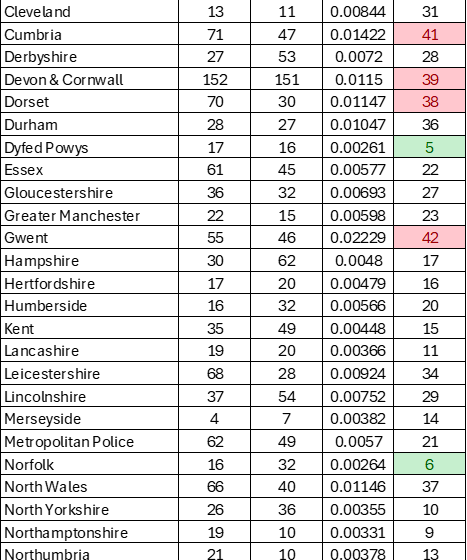
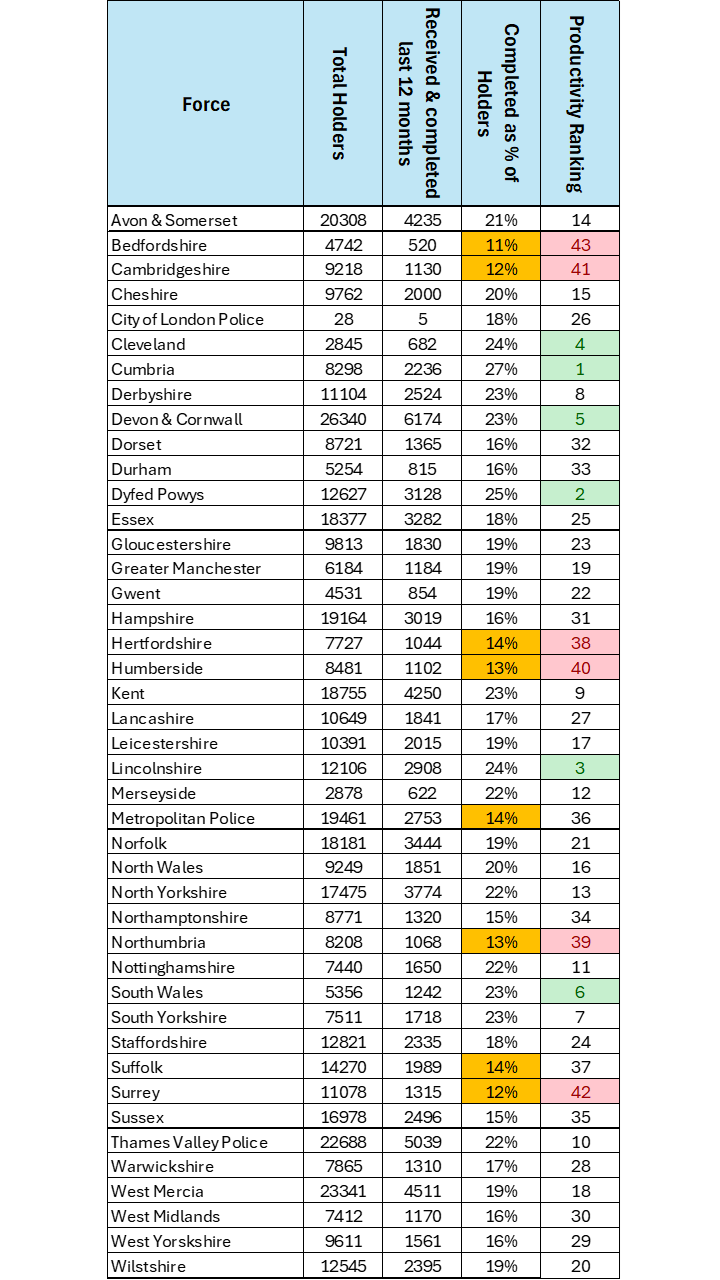
Using the approach detailed above I have ranked each force on this basis to enable comment on productivity and comparison between forces.
The yellow highlight shows a percentage which is lower than would be expected and the red and green show top and bottom 15% respectively.
If the image does not display well on the screen go down to the bottom of the article and view it via the gallery.

Chapter 3 – Appetite for Revocation or Refusal
Revocations and refusals are legal means by which a force can remove an existing certificate or deny the issue of a new certificate. Both of these measures have a right of appeal to your local Crown Court. However, in practice this is infrequently used because of the prohibitive costs involved. For someone challenging a police decision:
- The best-case scenario is a £6,000 (approx.) legal bill and the return of your firearms.
- The worst case scenario is a £12,000 – 15,000 legal bill and you remain without your guns.
This is because the person bringing the action is responsible for their own legal bill if they win or usually have to pay for police costs if they lose.
There are a number of factors that can make you more likely to find yourself in this situation and probably the most significant is your postcode!
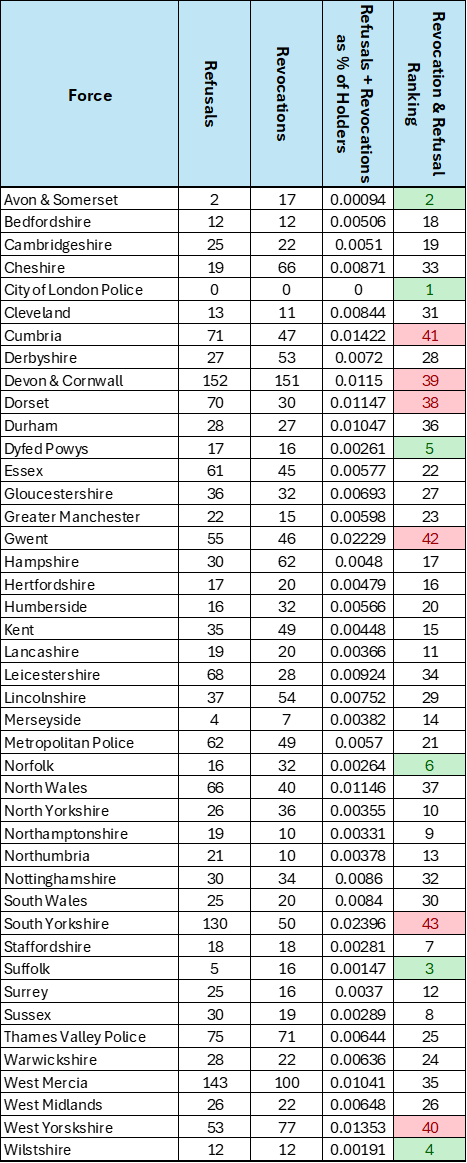
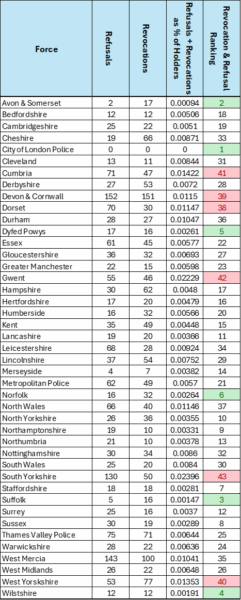
Someone in South Yorkshire is 25 times more likely to find themselves in this situation than if they lived in Avon & Somerset.
Therefore, the rate of revocations and refusals issued by a force is important information for a shooter.
3 – The Detail
It would be unfair to use the numbers of revocations and refusals on their own because that does not take into account the size of the force and numbers of certificate holders.
It would be reasonable to assume that force A with twice the numbers of holders of force B might reasonably issue twice the numbers of revocations as a result.
To give some clearer idea of individual forces approach in this area I have added together the number of revocations and refusals issued in a yearly period and divided this by the total number of certificate holders. This gives a percentage that we can use to rank forces and give a clearer idea of what is going on in this area.
3 – The End Result
Chapter 4 – Trends
1. Productivity Changes
- Most forces show a decline in productivity from Q3 2024/25 to Q2 2025/26. During the three periods the total numbers of files completed across the UK starts at 115,500, then goes down to 100,500 and finishes on 91,700. That’s an overall decrease of 20% which is highly concerning and begun before the latest version of Statutory Guidance was issued.
- Several forces, such as Cumbria and Dyfed Powys, have managed to maintain or slightly improve productivity over the period.
- Surrey: Experienced the largest drop in productivity from 3,950 (which seems very high) to 1,315
- Cumbria: Shows consistently high productivity and even a slight increase, bucking the national trend. Cumbria is 2.5 times more productive than the lowest performing Force Bedfordshire.
2. Holders Change
- The number of certificate holders is decreasing across all forces. In total 17,779 Certificate Holders have been lost since
- The largest reductions are seen in, Metropolitan Police (-1,479), Devon & Cornwall (-1,041), and Norfolk (-1,009) have the largest reductions.
3. Refusals and Revocations
- The percentage of refusals and revocations as a proportion of holders remains relatively stable across all periods.
- The highest proportion of refusals and revocations are seen in South Yorkshire, Gwent and Cumbria.
- The disproportionate nature of the refusals and revocations rate continues to be seen. A Certificate Holder’s postcode can make them over 25 times more likely to be revoked (South Yorskshire v Avon & Somerset).
4. Temporary Permits
- The number of temporary permits issued has increased from 1,501 to 2,089. This is a 38% increase and is a clear warning of a system under significant strain.
- The biggest increases in numbers of permits are seen in Humberside (by a huge margin) followed by Bedfordshire. Several smaller increases are seen across Forces such as Surrey, Suffolk and Staffordshire.
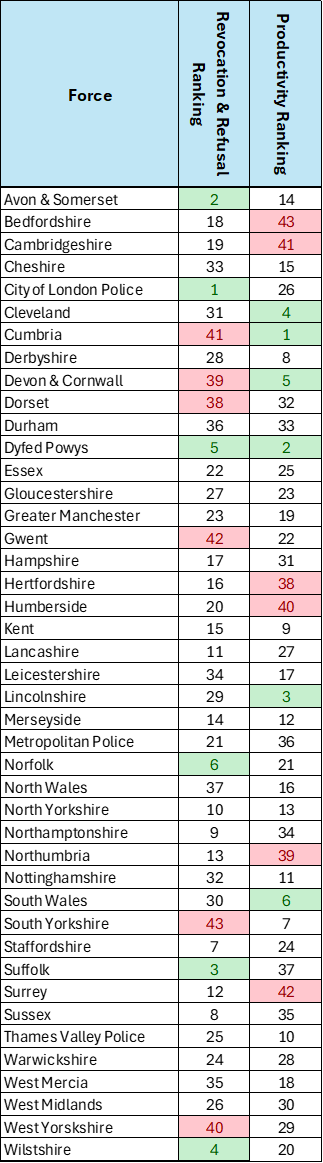
Summary Chart –
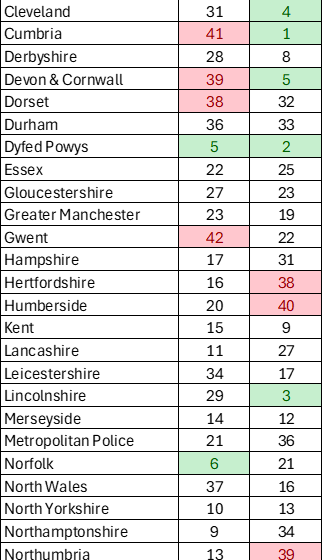
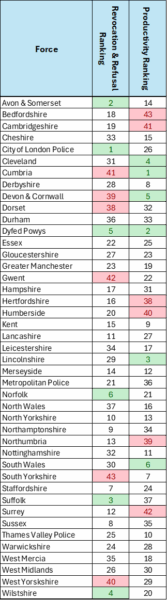
The following chart summarises my assessment of where each Force ranks according to Productivity and Revocation & Refusals. If this does not display on your mobile device please open it via the gallery below.
In Conclusion:
The current presentation of firearms licensing statistics reveals a troubling lack of clarity, consistency, and methodological transparency from the police. These figures are not just confusing; they risk misleading stakeholders and undermining public trust.
Under the UK Statistics Authority’s Code of Practice for Statistics, official data must uphold the principles of trustworthiness, quality, and value. That means clear definitions, robust methods, and relevance to users.
Firearms licensing affects public safety, individual rights, and operational accountability. If we are to govern it fairly, the data must meet the same standards of integrity we expect from the system itself.
Transparency is not a luxury. It’s a duty.