Install on your iOS device:
Tap then "Add to Home Screen"
  • SUPPORTING RESPONSIBLE SHOOTING

Free Content

Behind the Numbers 2

Behind the Numbers 2 2560 1708 Chris Downs

Introduction

There are lies, damned lies and statistics… but credible national information on firearms licensing is vital for the shooting community.

This is especially important when:

  • Licensing Fees have doubled – What are we getting for the extra money?
  • Backlogs are widespread and these delays threaten the future of the sport.
  • Numbers refused / revoked are at the highest levels since records began.

Previously, I have been critical on the available information. The first article in this series can be found via this link – https://firearmslicensing.net/behind-the-numbers/

Following this I wrote to the National Police Chief’s Council lead raising my concerns and received this reply on 17th August 2025:

what we will be doing with the recent end of July data capture to ensure it can be interpreted by anyone wanting to understand their local firearms licensing performance and compare this nationally.

This updated information can be found via these links:

https://www.npcc.police.uk/SysSiteAssets/media/downloads/publications/publications-log/operations/2025/firearms-licensing-2526-q1-headlines.pdf

https://www.npcc.police.uk/SysSiteAssets/media/downloads/publications/publications-log/operations/2025/firearms-licensing-2526-q2-headlines.pdf

In this article, which will be regularly updated, I walk you through my assessment of the figures provided step-by-step. If numbers aren’t for you then skip to “The End Result” of each section to see the final conclusions.

If viewing on a mobile device please note – All images will be available via the gallery at the bottom of this article which will make them easier to read.

Please note– I am not a statistician and errors can be made. The following is presented in good faith and any required corrections that are highlighted will be addressed and apologies offered if necessary.

Chapter 1 – Complete in 4 months

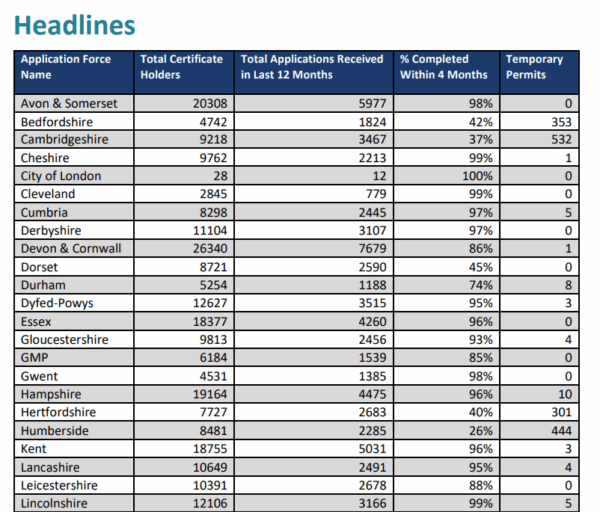
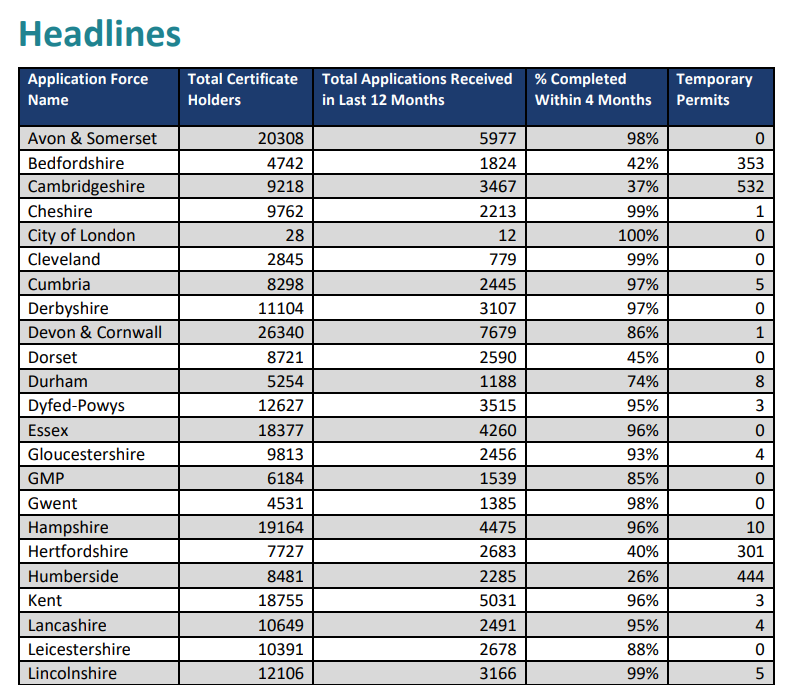
The “Headlines” at the start of the documents look like this.

It’s usual to present key information at the start of a document (not everyone likes numbers as much as I do!) but are they the right numbers?

It’s very natural to read numbers presented next to each other as being linked together. The column “Total Applications Received in last 12 months” and “% Completed Within 4 Months” are right next to each other.

So looking at Bedfordshire we see 1,824 application have been received and 42% completed within 4 months but what does that tell us? Not what we first think…

The Guidance Notes (See below) make it clear that the “completed in 4 months” percentage is not a percentage of all the applications received but rather a percentage of those received and completed within 12 months.

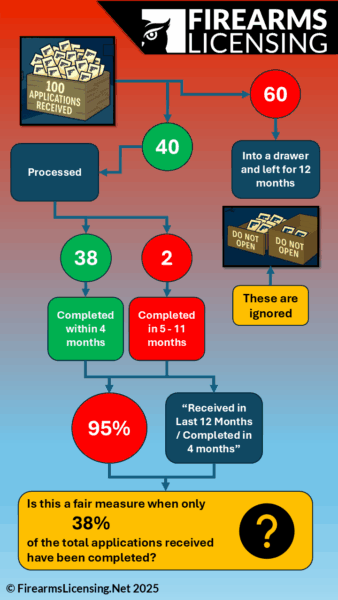
It’s not easy to understand why these are presented in this was but it can seriously distort your perception of what is going on. To try and explain the risks with this information as clearly as possible I have created this fictitious example.

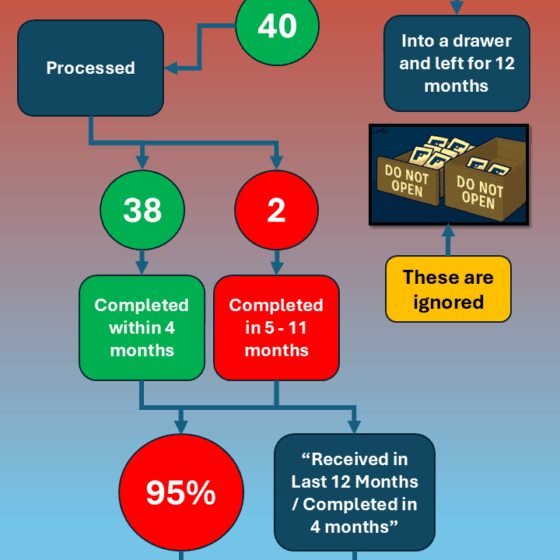
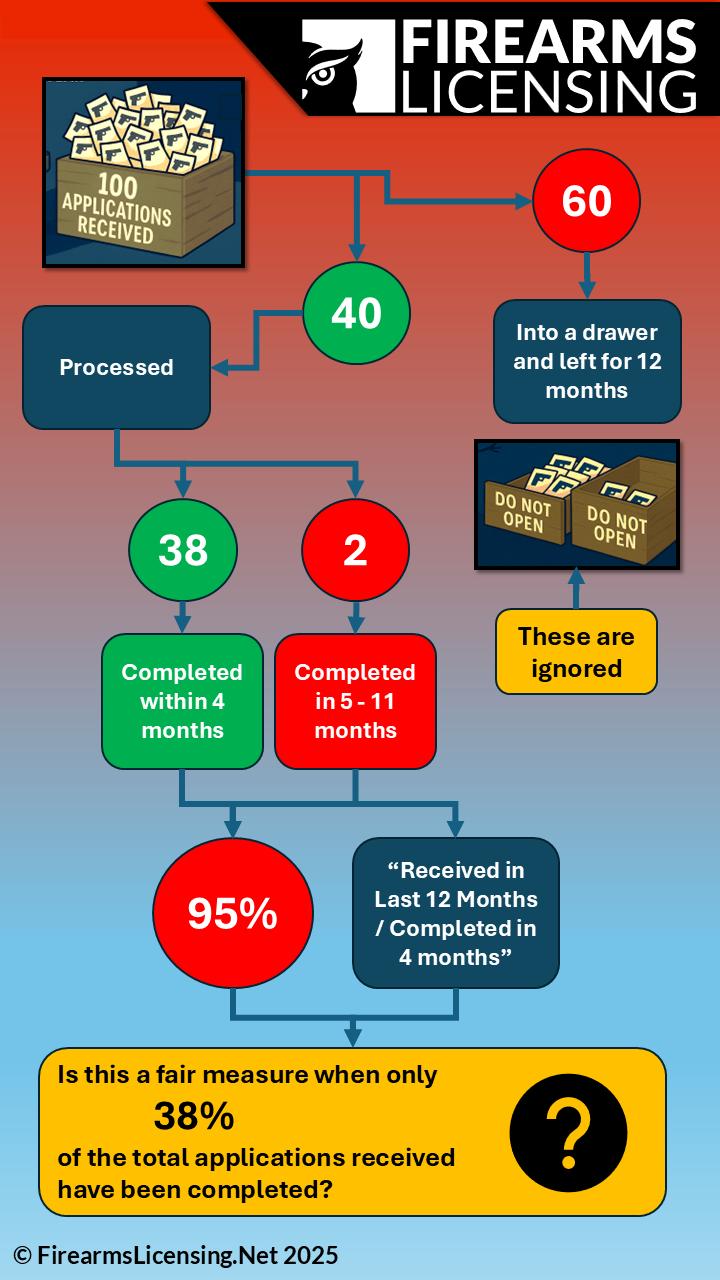
I receive 100 applications and put 60 into a drawer – I do nothing with these. The remaining 40 I work on and complete 38 within 4 months. The remaining 2 take slightly longer. Of those 40 applications I have processed 95% (38/40 = 95%).

But, in reality only 38% of all applications received have been completed within 4 months.

1 – The Detail

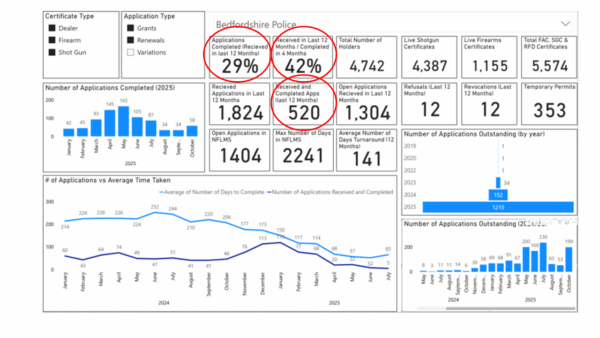
Going back to Bedfordshire this means that if we want to know how many of the applications were completed in 4 months as a percentage of all applications received we need to look closer.

  • 1,824 applications received in the last 12 months. 520 of those were completed.
  • Of those 520 completed 42% were completed within 4 months = 218
  • 218 is 12% of 1,824

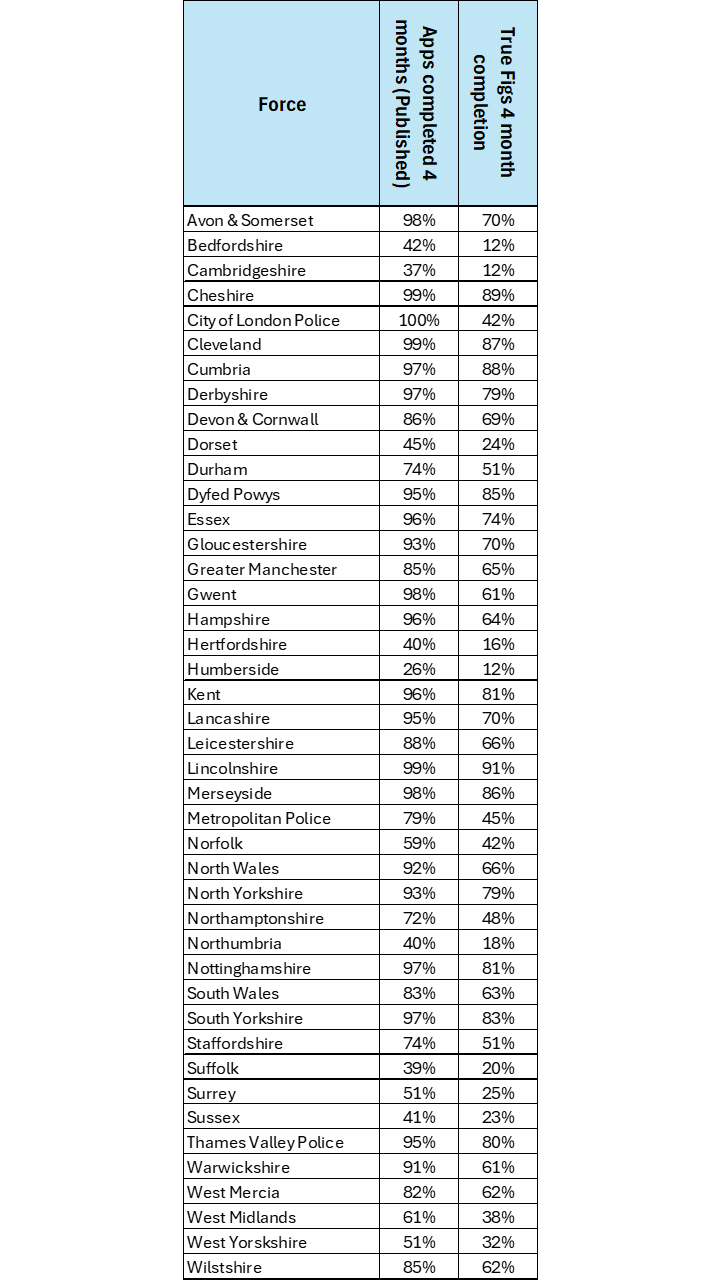
1 – The End Result

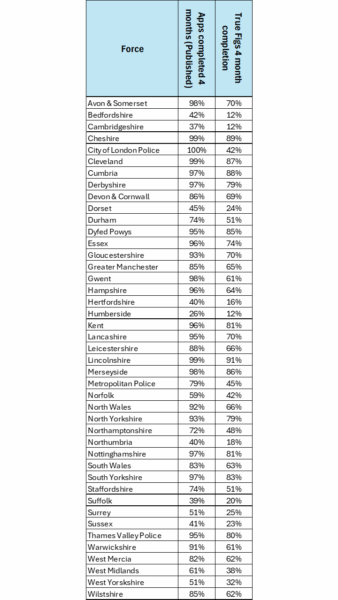
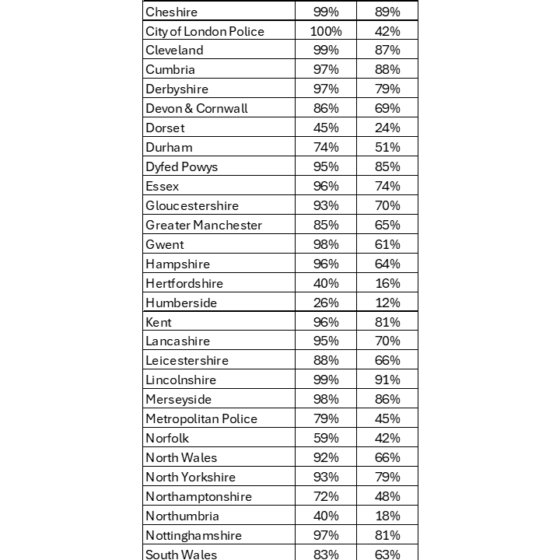
If we follow this methodology then the results look very different and arguably give a much more accurate idea of performance in this area.

If the image does not display well on the screen go down to the bottom of the article and view it via the gallery.

Across the majority of police forces we now see a very different picture emerging. Taking Gwent as an example we go from 98% (which seems very impressive) to 61%.

Why 4 months?- There is actually some science and background as to why this is important. The Firearms Act 1968 gives those applications received more than 8 weeks before expiry an automatic extension of a further 8 weeks. So 16 weeks in total (4 months ish) is the expected processing time contained in the primary source of law in this area.

Chapter 2 – Productivity

Firearms licensing is a complex system with many variables. The detailed information presented on each individual force is useful but going back to the National Police Chief’s Council (NPCC) earlier comment on what their ambition was for these statistics:

ensure it can be interpreted by anyone wanting to understand their local firearms licensing performance and compare this nationally.

This is what the detailed force data looks like. Does it achieve their aim and allow anyone to understand and compare? 

2 – The Detail

The balance between making something simple enough to be useful and acknowledging the complexities is difficult and no single measure will ever be perfect.

The other complication is that no two forces are working in the same way and the data, particularly on timeliness, is open to abuse. If a force chooses to leave a new application for a month before placing it onto the system or grant the certificate as soon as it’s received the system will not recognise this and the impact on “performance” will be significant.

The NPCC have set out their expectation below but all the evidence suggests that data manipulation remains widespread.

NPCC Firearms Licensing expects all forces to place firearm, shotgun and registered firearms dealer (RFD) grant and renewal applications onto NFLMS within a brief time of receipt to ensure accurate recording of data. Equally, NFLMS should only be updated to show ‘granted’ when the new certificate is ready for print and onward forwarding to the applicant.

To try to solve these issues I have kept it simple and just considered:

  • Certificate Holders
  • Applications received and completed in last 12 months

This allows us to make a comparison of actual work completed against the numbers of Certificate Holders (the size of the unit).

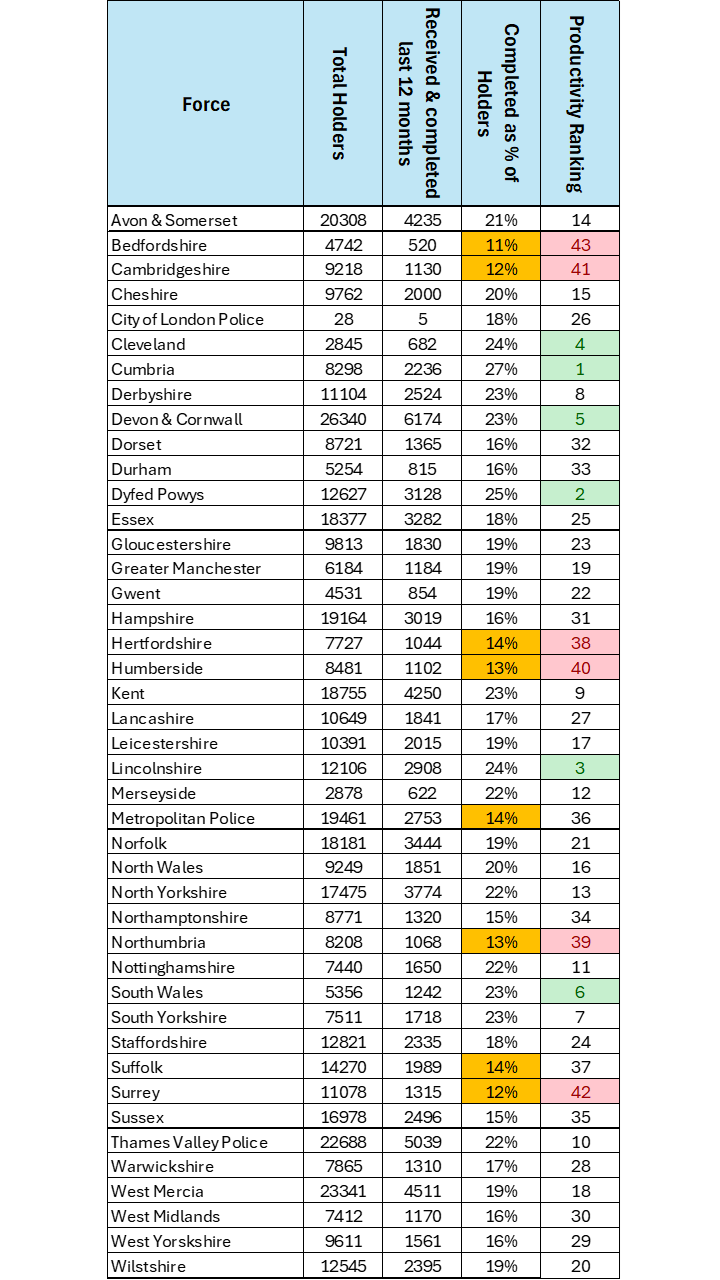
As a very rough rule of thumb if 20% of applications are completed in one year then the force is managing to keep pace with their existing numbers of certificate holders.

2 – The End Result

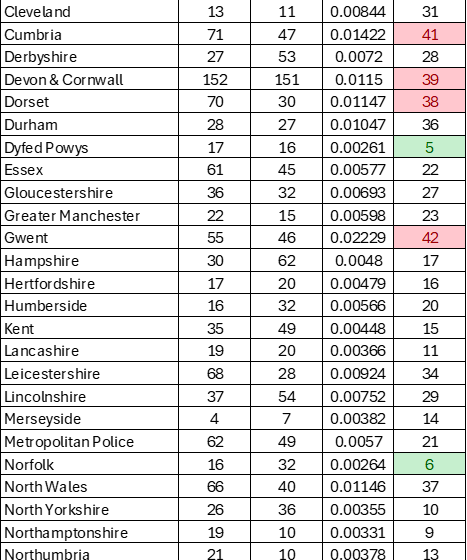
Using the approach detailed above I have ranked each force on this basis to enable comment on productivity and comparison between forces.

The yellow highlight shows a percentage which is lower than would be expected and the red and green show top and bottom 15% respectively.

If the image does not display well on the screen go down to the bottom of the article and view it via the gallery.

Chapter 3 – Appetite for Revocation or Refusal

Revocations and refusals are legal means by which a force can remove an existing certificate or deny the issue of a new certificate. Both of these measures have a right of appeal to your local Crown Court. However, in practice this is infrequently used because of the prohibitive costs involved. For someone challenging a police decision:

  • The best-case scenario is a £6,000 (approx.) legal bill and the return of your firearms.
  • The worst case scenario is a £12,000 – 15,000 legal bill and you remain with guns.

This is because the person bringing the action is responsible for their own legal bill if they win or usually have to pay for police costs if they lose.

There are a number of factors that can make you more likely to find yourself in this situation and probably the most significant is your postcode!

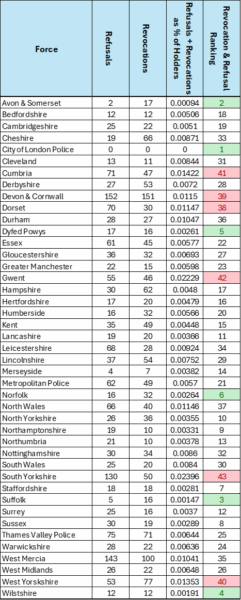
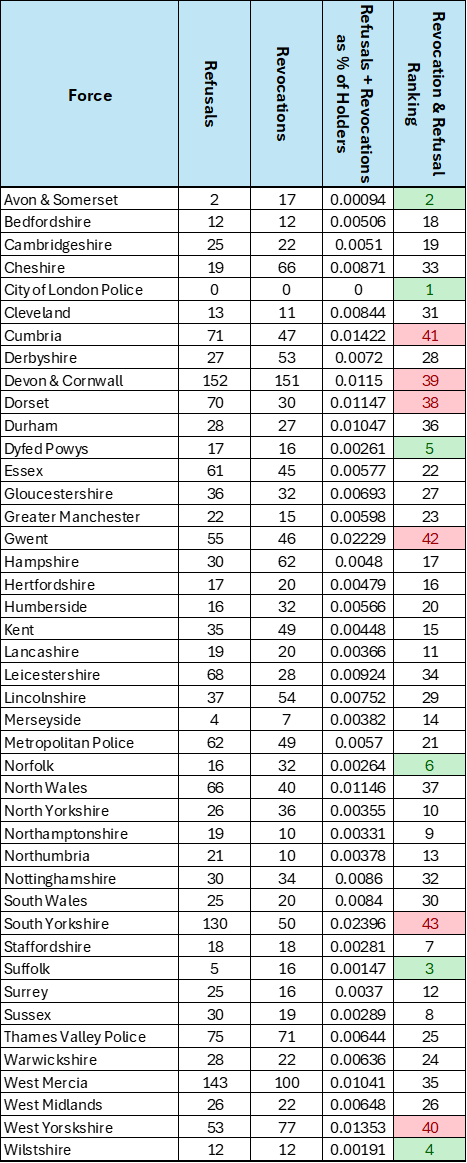
Someone in South Yorkshire is 25 times more likely to find themselves in this situation than if they lived in Avon & Somerset.

Therefore, the rate of revocations and refusals issued by a force is important information for a shooter.

3 – The Detail

It would be unfair to use the numbers of revocations and refusals on their own because that does not take into account the size of the force and numbers of certificate holders.

It would be reasonable to assume that force A with twice the numbers of holders of force B might reasonably issue twice the numbers of revocations as a result.

To give some clearer idea of individual forces approach in this area I have added together the number of revocations and refusals issued in a yearly period and divided this by the total number of certificate holders. This gives a percentage that we can use to rank forces and give a clearer idea of what is going on in this area.

3 – The End Result


Chapter 4 – Trends

1. Productivity Changes

  • Most forces show a decline in productivity from Q3 2024/25 to Q2 2025/26. During the three periods the total numbers of files completed across the UK starts at 115,500, then goes down to 100,500 and finishes on 91,700. That’s an overall decrease of 20% which is highly concerning and begun before the latest version of Statutory Guidance was issued.
  • Several forces, such as Cumbria and Dyfed Powys, have managed to maintain or slightly improve productivity over the period.
  • Surrey: Experienced the largest drop in productivity from 3,950 (which seems very high) to 1,315
  • Cumbria: Shows consistently high productivity and even a slight increase, bucking the national trend. Cumbria is 2.5 times more productive than the lowest performing Force Bedfordshire.

2. Holders Change

  • The number of certificate holders is decreasing across all forces. In total 17,779 Certificate Holders have been lost since
  • The largest reductions are seen in, Metropolitan Police (-1,479), Devon & Cornwall (-1,041), and Norfolk (-1,009) have the largest reductions.

3. Refusals and Revocations

  • The percentage of refusals and revocations as a proportion of holders remains relatively stable across all periods.
  • The highest proportion of refusals and revocations are seen in South Yorkshire, Gwent and Cumbria.
  • The disproportionate nature of the refusals and revocations rate continues to be seen. A Certificate Holder’s postcode can make them over 25 times more likely to be revoked (South Yorskshire v Avon & Somerset).

4. Temporary Permits

  • The number of temporary permits issued has increased from 1,501 to 2,089. This is a 38% increase and is a clear warning of a system under significant strain.
  • The biggest increases in numbers of permits are seen in Humberside (by a huge margin) followed by Bedfordshire. Several smaller increases are seen across Forces such as Surrey, Suffolk and Staffordshire.

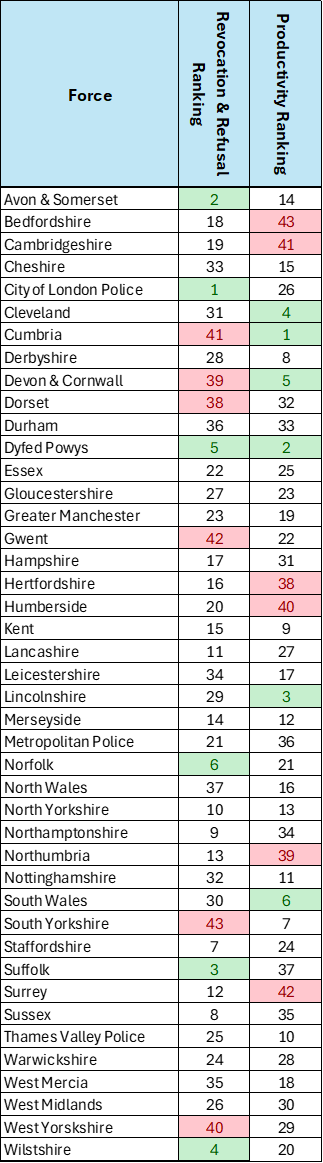
Summary Chart –

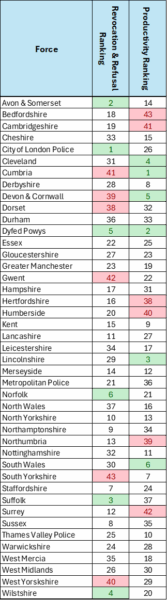
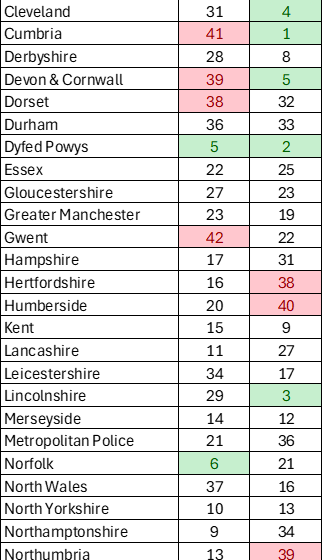
The following chart summarises my assessment of where each Force ranks according to Productivity and Revocation & Refusals. If this does not display on your mobile device please open it via the gallery below.

In Conclusion:

The current presentation of firearms licensing statistics reveals a troubling lack of clarity, consistency, and methodological transparency from the police. These figures are not just confusing; they risk misleading stakeholders and undermining public trust.

Under the UK Statistics Authority’s Code of Practice for Statistics, official data must uphold the principles of trustworthiness, quality, and value. That means clear definitions, robust methods, and relevance to users.

Firearms licensing affects public safety, individual rights, and operational accountability. If we are to govern it fairly, the data must meet the same standards of integrity we expect from the system itself.

Transparency is not a luxury. It’s a duty.


Gallery – Chapter 1


Gallery – Chapter 2


Gallery – Chapter 3


Gallery – Chapter 4

Backlogs & BCH

Backlogs & BCH 1536 1024 Chris Downs

Introduction:

Bedfordshire, Cambridgeshire and Hertfordshire (BCH) police forces collaborate when it comes to firearms licensing.

We’re committed to working constructively with this Tri-Force team as they navigate significant delays.

But let’s be clear: the rights of the public, the law and police obligations matter now more than ever.

Understanding your rights isn’t about confrontation, it’s about ensuring fair, lawful treatment in a system that serves both public safety and individual responsibility.

It’s why we’ve put together this free article which analyses the position and key messages that can be found on the service updates page of the individual Forces.

It provides some guidance on the main issues and also has links to further information.

Service Updates:

Each force has published its own update. The text appears identical but here’s where to find them:

Bedfordshire – https://www.beds.police.uk/advice/advice-and-information/fi/bch/firearms-licensing-service-update/

Cambridgeshire – https://www.cambs.police.uk/advice/advice-and-information/fi/bch/firearms-licensing-service-update/

Hertfordshire – https://www.herts.police.uk/advice/advice-and-information/fi/bch/firearms-licensing-service-update/

Reasons for delay:

This service update begins by explaining that the current levels of service offered are as a result of:

  • Statutory Guidance – The changes to the requirement on police have resulted in extra work in the form of additional checks and scrutiny.
  • Increased demand – further clarity on what this entails would help applicants plan more effectively.

There is no doubt that Statutory Guidance has imposed a more rigorous series of checks but this has been consistent across the UK and was first issued in November 2021.

In addition to this, if we examine the combined output from BCH over the last 5 years it does not seem to support the mentioned increase in demand.

Note – For the sake of simplicity (and because not everyone likes lots of data like me) I have only considered shotgun grants and renewals over the past five years. This data is drawn from published Home Office Statistics and usually represents the bulk of a firearms licensing departments work.

Key Messages:

These are drawn from the service updates that can be found on their website but also include links to further practical guidance on the various issues raised:

1) Renewals are taking around 9 months – BCH ask you to submit your application at

“least 20–24 weeks before expiry to avoid falling foul of Section 1 of the Firearms Act 1968”.

Ensuring you do not fall into unlawful possession is vital and we would always recommend working with the requirements of your firearms licensing team

BUT… what if you don’t read the website or can’t submit a renewal application that early?

The law states that an application for renewal received not less than 8 weeks before expiry benefits from an 8 week extension.

Statutory Guidance states that the renewal should be complete by the original expiry date unless “exceptional circumstances” apply and then the Police have a further period which acts as a safety net (The 8 week extension)

Provided you submit in the timeframe above your expectation should be that your renewal will be complete.

Why this is so important relates to the issue of storage and whether the police will expect you to arrange and pay for it while they process your renewal.

The police are not obliged to provide secure storage but according to Statutory Guidance the police should:

the police should work with the applicant to make the necessary arrangements for the safe, legal storage of their property until such time as the application is decided, or the police may consider the issue of a temporary permit, issued in accordance with section 7 of the Firearms Act 1968.

The links below will lead you to 2 articles that are highly relevant to his and provide further detail.

Renewal delays https://firearmslicensing.net/delays-renewals/

Provides an overview of how firearms / shotgun certificate holders can navigate the renewal process, particularly in the event of delays.

It explains the legal framework, statutory expectations, and the options available when processing takes longer than anticipated.

Temporary Permits https://firearmslicensing.net/temporary-permits/

Temporary Permits were designed to bridge short gaps—not to become a workaround for systemic delays. Responsible shooters deserve timely, fair treatment.

2) Grants are facing a minimum 12-month wait – but from our customers we know that this is typically significantly longer.

Grant Delays https://firearmslicensing.net/grant-delays/

This article addresses delays in the processing of firearms certificate grants, highlighting how factors like COVID-related backlogs, the Keyham tragedy, and the introduction of statutory GP requirements have slowed the system. It explains that while the NPCC suggests a 4-month timeline for “non-complex” grants, this varies widely across forces. The piece offers practical steps applicants can take to streamline their application and suggests escalating if necessary.

3) Accurate applications are critical – You should double-check your paperwork before submission.

 Accurate Applications https://firearmslicensing.net/application-process/

This article provides detailed guidance on completing the UK firearms application form (Form 201), emphasising accuracy and transparency. It highlights the importance of avoiding false statements, ensuring all sections are completed correctly to prevent rejection.

In Summary:

Whether you’re renewing, applying, or stuck in limbo – don’t go it alone.

If you live in Beds, Cambs or Herts (or anywhere else) and want principled, practical support – join us today.

Use code BCH50off for a full year of guidance via our ultimate self-help guide for just £6.

Signing up couldn’t be easier:

  • Follow this link – Register.
  • Add your details to the simple registration form.
  • Select Essential Membership and enter discount code BCH50off.

Alternatively… if you want direct support and problem solving done for you... select the complete membership and leave it all to us. We will assess and understand your situation and then advocate on your behalf to resolve it.

Don’t go it alone and always feel free to reach out to us via this link.


Drug Tests

Drug Tests 2560 1707 Chris Downs

Introduction

Put simply, a drug is any substance that alters how the body or more importantly, the mind functions.

With this in mind I don’t think it’s controversial to say that illicit drug use and safe firearm ownership are not compatible.

But what does the law say and how should police decide on whether to conduct any test?

This guide covers the legal basis for drug testing, when it may be applied, and what to expect if you’re asked to undergo one.

The Law

A key principle of Firearms Licensing is the idea of danger to public safety or the peace. It is mentioned throughout legislation both in terms of grant, refusal and revocation of certificates.

In brief; it is defined as:

A danger to public safety or the peace exists if the applicant’s ownership of the firearm could result in harm to self or others or disturb good order in public.

The Guidance

Statutory Guidance (Aug ’25) directs police as to the checks that they should make in order to ensure that there is no danger to public safety. Within this document “additional non-routine checks” are detailed as follows:

2.55 Chief officers should carry out additional, non-routine, checks if, following the initial enquiries above, they believe them to be necessary to assess suitability fully.


Factors that merit the carrying out of additional checks will depend on the circumstances of each individual case. Police forces are responsible for determining when additional checks should be undertaken.


2.56 More generally, these checks may include, but are not limited to:

a drug or alcohol test

The critical parts are:

  • These tests are not routine
  • The need for them should be assessed on the individual circumstances
  • Police are responsible for deciding when additional checks should be undertaken.

The Practical Considerations

When the need for these checks is determined solely by the police it raises concerns about consistency and fairness in application.

There are two ways in which police might choose to apply these tests:

  • Police issue tests – Usually used for drug driving.
  • Independent testing – Where you are required to provide a sample to an independent laboratory for testing.

The independent laboratory option gives you reassurance that the test will be conducted in scientific conditions but they will charge you somewhere between £350 and £550 dependent on the type of test.

Note – Costs vary depending on the number of substances tested and whether segmented analysis is required.

In Conclusion

Illicit drug use is not prevalent in the shooting community.

Guidance emphasises that these tests are not routine and their use should be decided  on the basis of individual circumstances.

Refusing a test doesn’t automatically lead to revocation but it’s essential to understand your rights and the reasoning behind the request.

If you find yourself being required to complete such a test you are well within your rights to ask for an explanation as to why the test is necessary.

Only once you have received this explanation should you decide whether to comply.

In any case it is time to contact us via this link and get support from the experts.

Top-Venting, Top Priority

Top-Venting, Top Priority 1386 988 Chris Downs

Introduction:

The UK firearms regime is widely acknowledged as the strictest in the World and accordingly criminal access to firearms is highly restricted.

This lack of access has led to a trend of criminals converting readily available blank firers to fire live, usually improvised, ammunition.

Recent intelligence suggests that converted blank-firing pistols may now rival conventional firearms in terms of criminal use.

As a result, the National Crime Agency (NCA) is working with police in order to control this trend and further restrict access. This has already led to an amnesty of some Turkish manufacturers, and a further amnesty is planned for 2026 for Italian made models.

What has happened?

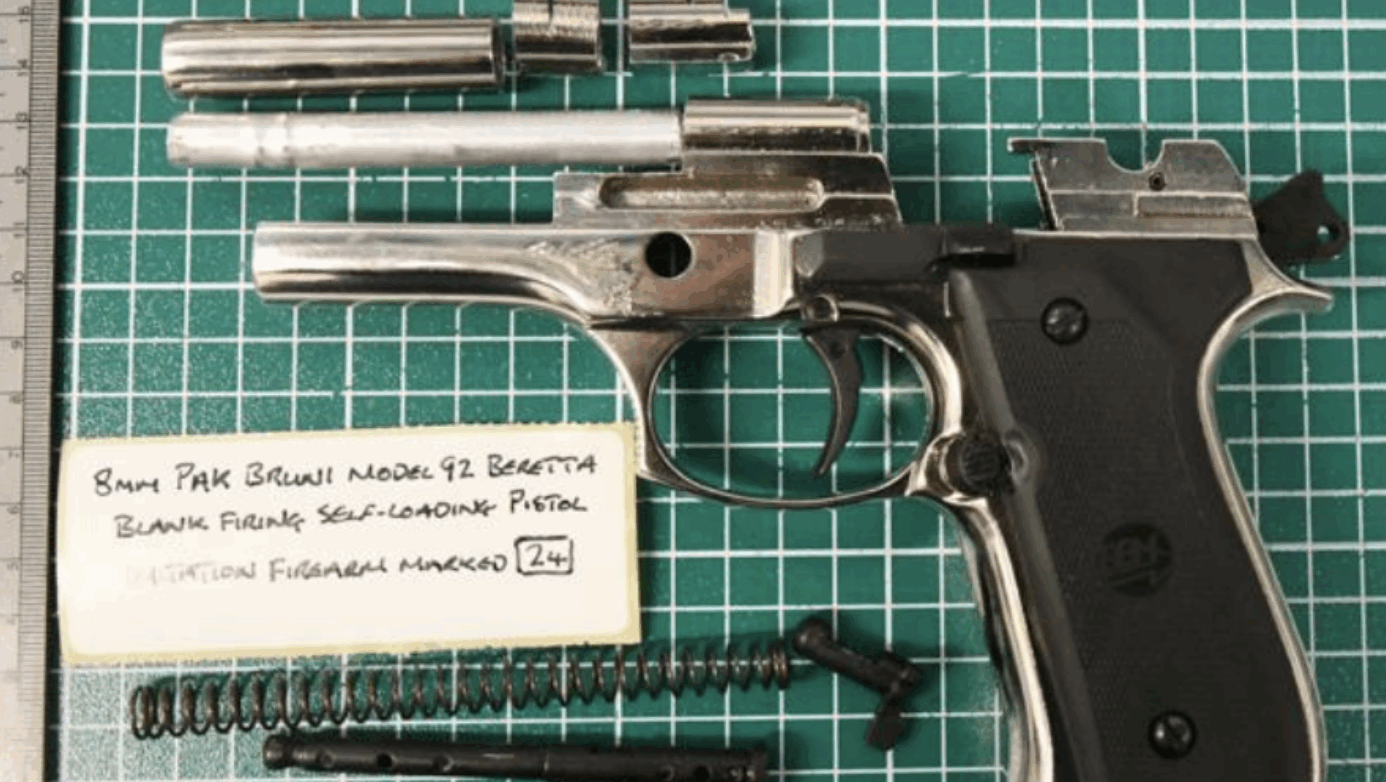
The National Crime Agency (NCA) has announced a new firearms amnesty, targeting five models of Italian-manufactured Bruni blank-firing guns that have been deemed readily convertible and therefore illegal under UK law.

Following forensic testing commissioned by the NCA and police found that the following models were found to be convertible with common DIY tools and without specialist skills:

  • 8mm PAK Bruni BBM Model 92
  • 8mm PAK Bruni BBM New Police
  • 8mm PAK Bruni BBM Model 96
  • 8mm PAK Bruni BBM Model ‘GAP’
  • .380R (9mmK) PAK Bruni BBM ME Ranger

This adds to an earlier exercise which confirmed that TVBFs made by the following brands are now considered illegal to own:

  • Retay
  • Ekol
  • Ceonic ISSC
  • Blow

Why has this happened?

These top-venting blank firers (TVBFs), while legal to purchase in their original state, have been increasingly recovered in criminal investigations after conversion to fire live ammunition. Since 2022, approximately 70 Bruni imitation firearms have been seized following criminal misuse.

This new amnesty builds directly on a 2025 initiative, which focused on four Turkish blank-firing models. That campaign resulted in nearly 3,000 firearms being surrendered across England and Wales.

The upcoming amnesty, scheduled for February 2026, offers a final opportunity for owners to surrender these Bruni models at police stations without facing prosecution. After the amnesty ends, possession of these TVBFs could result in up to 10 years’ imprisonment under section 5(1) of the Firearms Act 1968.

Retailers and importers have been instructed to cease trading these models, and Border Force will intercept any further importations. The initiative reflects a coordinated effort between the NCA, police chiefs, and Border Force to maintain the UK’s status as one of the safest countries globally in terms of firearms crime.

How does the law work?

In the most straightforward terms, the Firearms Act 1968 defines an imitation firearm and then Firearms Act 1982 defines the circumstances under which such an imitation will be a firearm in it’s own right.

In more detail,

An “imitation firearm” is defined in the Firearms Act 1968, section 57(4), as

 any thing which has the appearance of being a firearm […] whether or not it is capable of discharging any shot, bullet or other missile

The Firearms Act 1982 was enacted to close a potential loophole around items which could be easily converted into working firearms and as a result ensures that potentially dangerous items are treated as firearms even before conversion.

This Act introduces the term “readily convertible” and Sec 1(6) Firearms Act 1982 states:

For the purposes of this section an imitation firearm shall be regarded as readily convertible into a firearm to which section 1 of the 1968 Act applies if—

(a)it can be so converted without any special skill on the part of the person converting it in the construction or adaptation of firearms of any description; and

(b)the work involved in converting it does not require equipment or tools other than such as are in common use by persons carrying out works of construction and maintenance in their own homes.

In effect, the NCA is saying that they are satisfied that these makes / models can be converted into live firing weapons by the average person using tools which are commonly available to the general public.

While Section 1(6) of the 1982 Act references Section 1 firearms, the practical outcome in these cases is that classification under Section 5(1)(aba) of the 1968 Act as prohibited weapons (Handguns).

What has changed?

The most important part of this for owners / stockists of these models is that no laws have changed.

What has changed is the NCA and Police understanding of how easy the conversion process is and their ability to support any prosecution with expert evidence to support this position.

This is the reason why there is no compensation scheme for owners like we saw when the post-Dunblane 1997 changes to the law were enacted (“Handgun” surrender)

Final thoughts

The NCA and Police are not saying that all TVBFs are illegal. They are going through a process of proving that individual brands / models can be converted and declaring them illegal.

This means:

If you own a TVBF it is important that you follow updates in this area carefully to ensure that you are not unwittingly in possession of a prohibited firearm.

Also, prospective buyers should exercise caution, as further models may be reclassified and this could result in financial loss and legal exposure.

Link to the full NCA announcement

For further information please follow this link –

https://www.nationalcrimeagency.gov.uk/news/new-amnesty-announced-for-italian-made-blank-firing-guns-to-be-surrendered

Speaking Up, Staying Safe

Speaking Up, Staying Safe 2560 1602 Chris Downs

Introduction

If (like me) you sometimes have a limited span of attention here is the important message –

✅ Mental health issues are common and not automatically disqualifying

✅ Honesty is key—declaration builds trust

✅ Police are expected to treat you with dignity and respect

✅ Help is available, and seeking it shows strength

In the rest of this article I will explain some of the complexities and what you should expect.

More common than you think:

According to mind.org.uk – a leading mental health charity.

  • 1 in 4 people will experience a mental health problem of some kind each year in England.
  • 1 in 6 people report experiencing a common mental health problem (like anxiety and depression) in any given week in England.

What You’re Expected to Share—and Why It Matters

On application for grant / renewal an individual must honestly declare any “relevant” medical condition. Failure to do so is a criminal offence.

Failure to declare any diagnosis of any relevant condition during the life of the certificate is not a criminal offence but on the application form 201 it states:

I understand that I am expected to inform the police if I am diagnosed with, or treated for, a medical condition listed in note 5 while the certificate remains valid.

These condition in note 5 are:

  • Acute Stress Reaction or an acute reaction to the stress caused by a trauma, including
  • post-traumatic stress disorder
  • Suicidal thoughts or self harm or harm to others
  • Depression or anxiety
  • Dementia
  • Mania, bipolar disorder or a psychotic illness
  • A personality disorder
  • A neurological condition: for example, Multiple Sclerosis, Parkinson’s or Huntington’s diseases, or epilepsy
  • Alcohol or drug abuse
  • Any other mental or physical condition, or combination of conditions, which you think may be relevant.

It further states –

The list above is not intended to be exhaustive. A mental, physical or neuro-developmental condition may be relevant depending on the severity of the disorder and how it presents. If in doubt, consult your doctor or contact the police firearms licensing department.

This last point on “mental, physical or neurodevelopmental conditions” is a new addition following the recent Firearms Amendment Act 2025. This is a controversial and extraordinarily broad definition which could encompass conditions such as dyslexia. It’s natural to feel concerned but rest assured, severity and impact are what matter most.

If you are not affected on a day-by-day basis then it is highly unlikely to require declaration. If in any doubt contact your GP or police team.

What Happens If I Speak Up

Above all else – you should expect; a compassionate conversation.

The police will need to satisfy themselves that this development to your health will not impact on your safe possession and use of firearms. The law places a duty upon them to do so.

But the critical part is how that process takes place.

“Dignity and respect” is mentioned repeatedly in police authorised professional practice (APP) and a cornerstone of the expected standards of professional behaviour.

These principles are not optional and should form the basis for any interaction of this kind.

Your Rights, Safety and Dignity

Statutory Guidance to Police (Aug 25) states:

3.39 The fact that a person has received treatment for certain illnesses or conditions does not make them automatically unsuitable to possess a firearm.  It is one of the factors to be considered with all other evidence relating to the applicant’s character and history.  In such cases, account should be taken of the most recent medical information, and particular attention should be paid to whether this suggests to the police that the applicant’s condition impacts on their suitability to possess a firearm including where the condition is liable to recur or fluctuate or is unstable.

This is a very clear – There is no automatic link between a condition and being unsuitable to retain a firearm.

Offer of voluntary surrender

Dependent on the condition and severity it may be necessary for police to remove firearms. This should be in exceptional circumstances.

If you are offered a period of voluntary surrender this may be in your best interests but does require careful consideration.

Read this article to properly inform yourself of potential issues surrounding such a surrender – Voluntary Surrender – offered or considering

What other help is available:

The following document is a leaflet produced by National Police Chief’s Council in partnership with shooting and mental organisations it offers further reassurance on this subject and avenues of further support.

FMH-England-and-Wales-PRINT (1)

In conclusion:

Over the years I have made hundreds of assessments relating to an individual’s mental health. If you’ve taken steps to get help, that shows courage, self-awareness, and responsibility. These are exactly the qualities that would reassure me and that build trust in our licensing system.

Do not suffer in silence, help is available and support should be expected.

If you’re unsure what to declare or how to approach the conversation, speak to your GP or licensing team. You deserve clarity, compassion, and support.

Behind the Numbers

Behind the Numbers 2560 1708 Chris Downs

Introduction

This piece explores the troubling inconsistencies and lack of transparency in firearms licensing statistics across England and Wales.

Drawing on recent data releases, I highlight how misleading figures can obscure operational realities.

This article considers 3 key Data Sources:

  1. National Police Chief’s Council
  2. BASC Annual report (Police figures within)
  3. Home Office Firearms Licensing Statistics

National Police Chiefs Council

Firearms Licensing 2024/25 Quarter 4 Headlines (1 January 2025 to 31 March 2025)

This data can be found via this link:

https://www.npcc.police.uk/SysSiteAssets/media/downloads/publications/firearms-licensing-q4-headlines.pdf

Unfortunately, this actually gives us very little useful information, particularly as it is issued with no explanatory notes as to how the figures are calculated. As a result, there are more questions than answers.

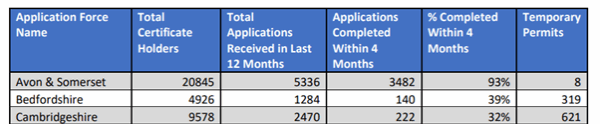
If we take a closer look at the first few Forces.

Avon and Somerset

The first 3 columns make sense. There’s a five year cycle of renewals so we might expect 4,500 ish renewal applications to be submitted in a year and the rest could be mostly made up of grants and variations.

At first glance I might be impressed that 93% of applications were completed within 4 months, as indicated in Column 5. However, if I take the numbers from columns 3 and 4 my sums look like this:

3483 / 5336 = 0.65 which translates to 65%.

So, something else must be going on here. It’s very natural to read columns of numbers and assume that they relate to each other, but it doesn’t look like this is the case here.

Perhaps the numbers mean that of the 5,336 applications received in the last 12 months 3,482 have been completed within 4 months of receipt and that this represents 93% of all applications received during the 3 month period that this information covers. In all honesty it’s impossible to say for certain.

I have sent an email (30Jul’25) requesting some further explanation from the National Police Chief’s Council. This email has been acknowledged but no details has been provided yet.

Bedfordshire

Moving these issues to one side the next Force up is Bedfordshire who according to this data have completed 140 applications within 4 months which is a reported 39% of the total.

Bedfordshire is part of a Tri-Force Alliance with Cambridgeshire and Hertfordshire, so direct comparisons are perhaps unfair but gives strong indication that the excessive delays in this Force are unlikely to be resolved soon.

BASC – Performance Report

The Performance of Police Firearms Licensing Departments in England and Wales 2025

This document can be found via this link – https://basc.org.uk/basc-publishes-most-comprehensive-firearms-licensing-report-to-date/

In this report BASC have completed the most complete report on Firearms Licensing to date, which is summarised on page 4 of the document.

To be very clear – The following observations are not intended as a criticism of BASC. The data in question has been provided by police from the National Firearms Licensing Management System (NFLMS).

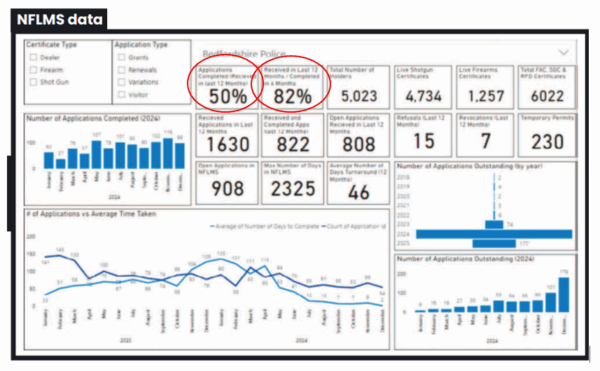
Each police force receives an individual section which includes other data obtained from the police via Freedom of Information Act (FOI) requests. This police data is shown below:

On the police data I have highlighted two key figures.

  1. Applications Completed (Received within last 12 months) – 50%
  2. Received in last 12 months / Completed in 4 months – 82%

The figures appear contradictory. If 50% of applications are completed overall, how can 82% be completed within four months? Without explanatory notes, these statistics risk misleading stakeholders.

I have sent an email (30Jul’25) requesting some further explanation from the National Police Chief’s Council. This email has been acknowledged but no details has been provided yet.

Home Office Statistics

The official Home Office Statistics are released on an annual basis, compiled by a named Statistician and comply with guidelines set down by the Office for Statistics Regulation.

They can be found via this link:

https://www.gov.uk/government/statistics/firearm-and-shotgun-certificates-april-2024-to-march-2025/firearm-and-shotgun-certificates-april-2024-to-march-2025#:~:text=2.-,Summary%20of%20statistics,with%2031%20March%202024%20(495%2C798)

Within the summary text this report states:

“482,612 shotgun certificates on issue as at 31 March 2025, a 3% decrease (-13,186) compared with 31 March 2024 (495,798). This is the sixth consecutive year there has been a decrease and marks the lowest number of shotgun certificates on issue since comparable records began.”


“334 new applications for firearm certificates were refused (5%), a 19% decrease compared with the previous year (414) but the second highest number since comparable records began, following the introduction of the NFLMS in 2007”


“1,073 new applications for shotgun certificates were refused (7%), a similar number to the previous year (1,072) and the highest since comparable records began, following the introduction of the NFLMS in 2007”


Within this document you can find data tables which give specific detail on key information on firearms licensing broken down into individual Forces.

It is within this document that you can compare Forces and identify the serious differences within them.

For example:

During the course of 12 months – South Yorkshire consider 378 grant applications for shotgun certificates and refuse 77 of these.

During the same time period – North Yorkshire consider 550 grant applications for shotgun certificates and refuse only 9 of these.

These figures indicate that living South of the M62 makes you 12.5 times more likely to be refused than if you live on the North of it!

(Note – The Border between Forces isn’t that simple but illustrates the point)

In Conclusion:

The current presentation of firearms licensing statistics reveals a troubling lack of clarity, consistency, and methodological transparency from the police. These figures are not just confusing; they risk misleading stakeholders and undermining public trust.

Under the UK Statistics Authority’s Code of Practice for Statistics, official data must uphold the principles of trustworthiness, quality, and value. That means clear definitions, robust methods, and relevance to users.

Firearms licensing affects public safety, individual rights, and operational accountability. If we are to govern it fairly, the data must meet the same standards of integrity we expect from the system itself.

Transparency is not a luxury. It’s a duty.

Shotguns aren’t the problem

Shotguns aren’t the problem 2560 1707 Chris Downs

Summary

The Home Office may soon collapse two distinct licensing regimes into one. This move risks undermining public safety, destabilizing lawful ownership, and ignoring the true lessons of Keyham.

Introduction

On 29 June 2023, the Home Office launched a public consultation on proposed changes to UK firearms licensing. These proposals stem from high-profile reviews, including:

  • The Prevention of Future Deaths report following the tragic shooting in Keyham, 2021
  • The Independent Office for Police Conduct’s assessment of Devon and Cornwall Police’s handling of the case
  • The Scottish Affairs Committee’s inquiry into regional firearm regulations
  • The Coroner’s Warning—and Government Response

In his report, Senior Coroner Sir Ian Arrow expressed concern over the statutory presumption that certificates “shall be granted” unless specific criteria are not met. He recommended reversing this—requiring applicants to first prove their suitability.

The Home Office replied:

We have carefully considered your point… but do not agree… Sections 27 and 28 are drafted to support consistency in police decision-making and give certainty to the applicant… This supports public safety…

This exchange reveals a tension between professional opinions that we now see changed under the current UK Government.

Why Do We Have Two Regimes?

Shotguns were historically treated as culturally distinct from pistols and rifles, due to their use in agriculture and sport. As such, they were not originally subject to the same controls.

In fact, the law specifically states that shotgun possession should not be restricted to those who intend to use them or lend them to others to use (See Sec 28(1B) Firearms Act 1968). This enables possession of heirlooms, antiques and for other diverse reasons.

The History

  • Firearms Act 1920: Targeted pistols and rifles feared to be misused by revolutionaries. Shotguns, which were commonplace, were excluded.
  • Firearms Act 1937: Mentioned shotguns for the first time, defining them as having barrels at least 20 inches long (now 24″).
  • Firearms Act 1968: Consolidation: In response to rising crime involving “sawn-off” shotguns, this Act introduced Section 2 shotgun certificates with less stringent requirements than Section 1 firearms.

This historical position reflects not just convenience, but public consensus—recognising practical and cultural differences.

The likely affects of alignment

The proposal to require shotgun holders to justify each firearm (as under Section 1) would:

  • Overwhelm disposal channels: If holders relinquish shotguns en masse, lawful disposal pathways (RFDs & Police) may fail—raising risks of diversion.
  • Put shooting at risk: Thousands may surrender certificates, not due to risk but because of increased red tape.
  • Strain police capacity: Additional scrutiny means more checks, longer processing times, and resource reallocation.
  • Fail to address root causes: Keyham and similar tragedies involve failures of assessment and enforcement—not regime design.

Importantly, none of the past incidents cited would likely have been prevented by the proposed alignment. Legislation should be evidence-led, proportionate, and practical.

Conclusion:

Public Safety Must Lead—Not Political Optics

Shotgun and firearm regimes are different for good reason. Reform should enhance actual safety, not just the appearance of control. That means assessing holder suitability, ensuring enforcement consistency, and supporting lawful ownership—not destabilizing it.

The Home Office is expected to launch a second consultation later in 2025. Every stakeholder—shooting organisations, legal experts, certificate holders, and the public—must engage.

This isn’t administrative tidying. It’s a fork in the road for UK shooting culture. Reform must serve real safety—not just the illusion of control.

Pardon

Pardon 2560 1708 Chris Downs

Summary

Audiologist Carl Weldon explores the overlooked danger of hearing loss within shooting environments.

Drawing on over a decade of clinical experience, Carl breaks down how sudden impulse noise like gunfire can cause permanent sensorineural hearing damage. He explains the science behind it, outlines practical strategies for prevention—including electronic protection and double-layered ear defence—and provides clear pathways for those already affected by hearing issues.

Whether you’re a certificate holder, instructor, or simply part of the shooting community, this guest article is a must-read for understanding, preventing, and managing hearing loss.

Protect what you can’t replace. Every shot. Every time

Member Benefits

Protect your hearing and your wallet – Mansfield Wax & Hearing Clinic will offer 10% discount on all premium level hearing aids to all members of firearmslicensing.net.

Mention your membership when first making contact and show your digital / physical card on attendance.

They can be found at https://www.themansfieldwaxclinic.co.uk/

About Carl Weldon

Carl has been a BSc qualified Audiologist for over a decade. After first qualifying he worked within the NHS before moving to the private sector to be able to offer a wider range of services and technology. He set up The Mansfield Wax & Hearing Clinic in 2021 to address gaps in available Audiology services.

Hearing Loss and the Importance of Protection in the Shooting Environment

When we talk about firearms safety, most people immediately think of eye protection, safe handling, and secure storage. However, one often overlooked aspect of firearms safety is hearing protection.

Exposure to gunfire, even during controlled and lawful shooting activities, can cause permanent hearing damage; sometimes after just a single shot.

Understanding Sensorineural Hearing Loss

Sensorineural hearing loss (SNHL) is the most common type of permanent hearing loss. It is caused by damage to the delicate hair cells in the inner ear (cochlea) or to the auditory nerve pathways that transmit sound signals to the brain. Unlike conductive hearing loss, which can often be medically or surgically treated, sensorineural hearing loss is typically irreversible.

Loud noise, particularly sudden and intense sounds like gunfire, is one of the primary causes of SNHL. The inner ear contains thousands of tiny hair cells that respond to sound vibrations. When these cells are damaged, especially by high-decibel noise, they do not regenerate.

As a result, affected individuals may experience:

  • Difficulty understanding speech, particularly in noisy environments
  • Tinnitus (a persistent ringing or buzzing in the ears)
  • Permanent reduction in hearing sensitivity

How Gunfire Affects Hearing

Gunfire is an impulse noise, meaning it is extremely loud and occurs suddenly. The average gunshot can measure between 140 and 175 decibels, well above the threshold for immediate hearing damage (about 120 decibels). To put this in perspective:

  • 85 dB: the level at which prolonged exposure can cause damage (e.g. lawnmower)
  • 120 dB: the pain threshold
  • 140+ dB: immediate danger zone (typical for gunfire)

Even a single unprotected shot can cause instantaneous and permanent hearing loss, especially in confined spaces or indoor ranges where sound reverberates.

Risk Is Not Just for Shooters

It’s not only shooters who are at risk. Range officers, instructors, gun bearers and spectators are also.

Anyone in proximity to gunfire can suffer hearing damage if proper precautions are not taken. Cumulative exposure over time without protection drastically increases the risk.

How to Minimise the Risk of Hearing Loss

Fortunately, hearing loss from gunfire is entirely preventable. Here’s how you can protect yourself and others in the shooting environment:

Always Wear Hearing Protection

Use high-quality ear protection every time you are around gunfire, whether shooting or observing.

  • Earplugs: Foam earplugs offer good protection and are inexpensive, but they must be properly inserted.
  • Earmuffs: Over-the-ear muffs provide a higher noise reduction rating (NRR) and are often more consistent in their protection.
  • Double Protection: For maximum protection, especially with high-calibre firearms or indoor shooting, use both plugs and muffs simultaneously.

Use Electronic Hearing Protection

Modern electronic earmuffs protect against loud sounds while allowing you to hear speech and ambient noise. They are especially useful for communication on ranges or during instruction.

Limit Exposure

Reduce the amount of time spent in high-noise environments and take regular breaks away from the firing line to give your ears a rest.

Maintain Distance

When not actively shooting, stay behind safety barriers or further from the source of the gunfire. Distance reduces decibel exposure significantly.

Educate and Equip Others

If you’re an instructor, range officer, or experienced shooter, educate newcomers about the dangers of noise-induced hearing loss and ensure that hearing protection is both readily available and properly used.

Support for Those Already Affected by Hearing Loss

While prevention is crucial, many individuals in the shooting community have already experienced some level of hearing loss. If you are among them, know that support is available, and taking action can significantly improve your quality of life.

Hearing Assessments and Diagnosis

The first step is a professional hearing assessment. Audiologists can determine the type and extent of hearing loss and offer guidance on management options. Early intervention can also help prevent further deterioration.

Hearing Aids and Assistive Devices

Modern hearing aids are highly effective, discreet, and adaptable to different environments—including ranges and outdoor activities. There are also assistive listening devices and apps that enhance communication in noisy settings.

Tinnitus Management

For those experiencing tinnitus (ringing in the ears), various treatment strategies exist:

  • Sound therapy or masking devices
  • Cognitive behavioral therapy (CBT)
  • Mindfulness and relaxation techniques

These can help reduce the distress caused by chronic tinnitus.

Support Groups and Resources

Connecting with others facing similar challenges can be reassuring and informative. Look for:

  • Local or online hearing loss support groups
  • Veteran services (if applicable)
  • National charities or hearing health organizations that offer education and advocacy

Ongoing Education

Stay informed about hearing conservation, technological advances, and coping strategies. Even with existing hearing loss, protecting your remaining hearing remains essential.

Final Thoughts

Hearing is one of our most vital senses, yet it is all too easy to take it for granted—until it’s too late. In the shooting community, awareness of noise-induced sensorineural hearing loss must become just as routine as wearing safety glasses or checking that a firearm is unloaded. By adopting a proactive approach to hearing protection, shooters can continue to enjoy their sport or profession without sacrificing their long-term auditory health.

Stay safe. Shoot responsibly. Protect your hearing.

🩺 The Mansfield Wax & Hearing Clinic – Hearing Health Specialists

Located in Mansfield, this clinic provides expert audiology care with a focus on restoring and protecting hearing. Their services include:

Ear Wax Removal
Safe, painless microsuction performed by qualified audiologists. Ideal for shooters experiencing muffled hearing or discomfort due to wax buildup.
Hearing Assessments
Comprehensive evaluations to detect hearing loss early—especially valuable for those exposed to impulse noise like gunfire.
Hearing Aids
A wide selection from leading brands (Phonak, Starkey, Oticon), tailored to individual needs and lifestyles.
Personalised Care & Ongoing Support
Patients benefit from continuity with the same audiologist, advanced diagnostic tools, and a welcoming environment.

Intelligence Ahead

Intelligence Ahead 2560 1706 Vicky Downs

The document explores the strengths and limitations of AI in relation to Firearms Licensing

Introduction:

If I’m lucky, someone might say I’m a thinker and a tryer.

Less charitable voices might call it obsession… but let’s talk about AI and the results of my experimentation in this area.

The Rise of the Machines

The recent explosion in Artificial Intelligence (AI) has been fascinating to watch and potentially terrifying in equal measures.

Recent figures from employment search engine Adzuna suggest that vacancies for graduate roles, apprenticeships, internships and junior positions with no degree requirement have fallen by 31.9 per cent since November 2022, when ChatGPT was released.

The Beginnings of firearmslicensing.net

When I first thought about creating this resource my technology consultant asked me if AI would render the idea redundant.

As a result, we experimented with several available systems with initially very promising results.

But then I started noticing some things.

Hallucinations and Misdirection

Caselaw – Some of the references I was being provided with were brilliant but didn’t actually exist.

On this subject The Solicitors’ Regulation Authority (“SRA”) recently said this:

“All computers can make mistakes. AI language models such as ChatGPT, however, can be more prone to this. That is because they work by anticipating the text that should follow the input they are given, but do not have a concept of ‘reality’. The result is known as ‘hallucination’, where a system produces highly plausible but incorrect results.”

Looking Elsewhere – I would ask AI a question, tell it where to find the answer and then it would look somewhere else and come back with something else entirely.

For example, I was researching the use of mentor conditions on Firearms Certificates and asked

“Are there any mentor conditions found in Appendix 3 to the Home Office Guide to Firearms Licensing Law?”

The system confidently answered yes, presented me with a direct quote of the wording and a summary of when the use of these conditions might be applicable.

This would have been fine but it’s completely incorrect.

In Conclusion

AI is a fantastic tool, I use it frequently most days but for now there are some areas that are still outside of its reach.

So where does that leave us?
🛠️ AI is a powerful toolkit—but it’s not a compass.
⚖️ For personal, procedural or high-stakes matters, always pair tech with trusted expertise.
👥 The trick is knowing when to ask… and who to ask.
(That last advice? Courtesy of AI, ironically.)

Final Chapter for Lead

Final Chapter for Lead 1024 1024 Vicky Downs

The UK is phasing out lead ammunition by 2029. With a 3-year transition ahead, shooters must adapt to new rules.

Here’s what this shift means for the future of UK shooting.

Introduction:

On 10th July 2025 the Department for Environment, Food & Rural Affairs (DEFRA) announced a ban on “Toxic lead ammunition”.

Environment Minister Emma Hardy said:

“Britain is a proud nation of nature lovers, but our rivers are heavily polluted, and majestic birds are declining at an alarming rate.


This new ban on lead in ammunition for most uses will help reverse this – rejuvenating pride in our countryside by protecting precious birdlife and cleaning up rivers.


Non-lead alternatives are readily available, and we’ll continue to work closely with the shooting sector throughout this transition.”

🧑‍⚕️ This policy is driven by strong evidence of health risks, especially for children and wildlife.

🔄 A major transition away from lead is coming— use the 3-year transition period to plan ahead for alternative ammunition.

🧭 Enforcement is likely at retail level, so supply chains will feel the change first.

The Message – in Brief:

The UK Government plans to introduce legislation restricting sale and use of lead ammunition by summer 2026, followed by a three-year transition period ending in 2029.

It rejected earlier proposals for a five-year transition saying that this extended time period had taken impact to supply chains from Covid-19 into consideration.

  • 🗓️ Legislation introduced: Summer 2026
  • ⏳ Transition period: 2026–2029
  • 🚫 Full ban effective: 2029 – covering sale and use of lead shot and large-calibre bullets

Exemptions will remain for:

  • Military and police use
  • Elite athletes – proof will be required
  • Indoor Ranges
  • Outdoor ranges – provided control measures are present.
  • Small-calibre ammunition
  • Air weapon pellets
  • Collectors (Not for firing)
  • Academic and forensic work

Further detail:

Small Calibre – All calibres above 6.17mm (includes .243 and everything larger) intended for live quarry shooting will be restricted.

Packaging – All lead ammunition above 6.17 (.243) sold for target shooting will be labelled “must not be used for live quarry”.

Indoor use of lead shot – This will be formally restricted to ensure that the ban on lead shot generally can be effective at point of sale. This removes the possibility that any lead shot labelled for “indoor use only” would be used outdoors and closes this potential loophole.

Outdoor Target Ranges – Must be “permanent” – The detail of how this will be defined is unclear.

In conclusion:

Lead use can be traced back over 6,000 years in the widest variety of applications. It’s density, malleability and cost-effective nature are significant contributors to the longevity of its use.

Given the breadth of evidence, few would contest the rationale behind a transition away from but it seems as if the changes impacting on UK Shooting are happening almost monthly.

Having said this there is one section of the announcement that we would highlight:

“Alternatives to lead shot have become more efficient and widely available in recent years, with steel and tungsten-based shot being two popular options.


The government will continue to engage with the shooting industry to support the transition to alternative ammunition types.”

While non-lead alternatives are improving, uptake and availability remain varied.

We’d encourage the Home Office to remember that UK Shooting offers real benefits to both participants and the wider population. Moving forward meaningful consultation and engagement will be critical to ensure that this to ensure this shift does not feel disproportionate for UK shooting communities.

We’ll continue to monitor and update what this means for shooters, clubs, and retailers.

Back to top