Install on your iOS device:
Tap then "Add to Home Screen"
  • SUPPORTING RESPONSIBLE SHOOTING | Call us today:  07586 194458

Posts By :

Vicky Downs

Behind the Numbers 3

Behind the Numbers 3 2560 1708 Vicky Downs

Introduction

Firearms licensing performance doesn’t grab your attention but it quietly shapes the stability of the entire shooting sector. When forces fall behind, clubs feel the pressure, certificate holders lose confidence and organisations end up spending more time dealing with licensing problems than developing the sport.

It isn’t glamorous, but it matters and it matters more now than ever.

For years, the data behind firearms licensing has been difficult to access, inconsistently presented and in some cases fundamentally flawed. We’ve challenged the National Police Chief’s Council (NPCC) on these issues before, particularly around the way forces report timeliness but little has changed. The published figures still allow forces to appear more efficient than they really are – for example by delaying the point at which applications are entered onto NFLMS or by marking certificates as granted before they are actually issued. These practices distort the picture and make it harder for the shooting community to understand what is really happening.

And yet, despite these flaws, this is the first time that this level of information has been made publicly available. That alone is a step in the right direction. Transparency in firearms licensing has never been more important and even imperfect data can reveal meaningful patterns when analysed properly.

This article looks beyond the headline SLA figures and focuses instead on the measures that genuinely reflect operational performance: true productivity, revocation and refusal activity, and temporary permit usage. When viewed over time, these indicators show a system that is becoming increasingly uneven with some forces performing exceptionally well and others struggling with delays, backlogs and inconsistent decision‑making.

Understanding these trends isn’t just an administrative exercise. It’s about fairness, confidence and the long‑term health of shooting in the UK.

And that’s why it’s worth paying attention.

If you’re hungry for more detail check out:

Behind the Numbers 1 and 2 via these links –

Behind the Numbers

Behind the Numbers 2

At a Glance

In the last 18 months:

Certificate Holders – We started with 506,343 and at last count now have 476,079. That’s a loss of 30,264.

Temporary Permits – We started with 1,501 and at last count now have 3,092. That’s double and shows the strain the system is under.

Across Q4 25/26:

  • The same forces repeatedly appear in the top group across productivity and low permit usage (Cheshire, Lincolnshire, Cumbria, Derbyshire, Nottinghamshire).
  • The same forces repeatedly appear in the bottom group (Bedfordshire, Cambridgeshire, Hertfordshire, Humberside, Surrey, Sussex, West Yorkshire).
  • Forces who show high usage of their refusal and revocation powers (Devon & Cornwall, West Mercia, South Yorkshire) remain consistently high.
  • Temporary permit usage is the clearest indicator of stress and the Q4 data reinforces that pattern.

What all the numbers tell us is that UK firearms licensing is not a single system; it’s a patchwork of very different local realities. Some forces are delivering consistent, high‑quality work, while others are struggling with delays, backlogs, and heavy reliance on temporary permits.

True productivity varies dramatically and the published service level agreement (SLA) figures often mask deeper workflow problems.

Revocations and refusals remain low nationally, but intervention rates differ sharply between forces, reflecting local policy rather than national direction.

Overall, the system is stable in parts, fragile in others and increasingly defined by where you live rather than by national standards.

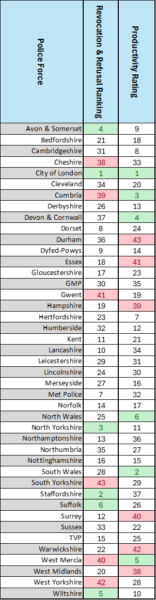
Q4 2025/26 – Where does your Force rank?

The following image is not perfect but it is designed to enable the average interested shooter to look at their Force and see what their performance is like in comparison to others.

Each Force is ranked from 1 to 43.

For revocation and refusal.

Ranking 1 is the area you are least likely to be refused / revoked.

Ranking 43 is the area where you are most likely to be refused / revoked.

Rank 43 is owned by South Yorkshire where you are almost 18 times more likely to be refused or revoked than if you lived in Staffordshire.

High rates do not necessarily indicate poor practice but it should ask the question – Is the shooting community of South Yorkshire really that different to the shooting community of Staffordshire?

For productivity

Ranking 1 is the Force that completes the most applications per year (Relative to their total number of certificate holders)

Ranking 43 is the Force that completes the least.

As a Force South Wales is almost twice as efficient as Durham.

References:

To see the data in full please visit –

https://www.npcc.police.uk/publications/All-publications/

and look in “Operations Coordination Committee”

Temporary Permits – Change Over Time

Transparency is not a luxury. It’s a duty.

Sec 1 Shotguns West Mercia

Sec 1 Shotguns West Mercia 2560 1859 Vicky Downs

Introduction

Across England and Wales, Section 1 shotguns are a normal, lawful part of shooting, pest control, gamekeeping and practical disciplines. They are authorised routinely by most police forces where the applicant demonstrates good reason and meets the expected security standards.

However, in recent months a number of certificate holders and applicants in West Mercia have reported difficulties obtaining authorisation for Section 1 shotguns.

Some have been told that:

  • Section 1 shotguns are “not normally authorised”,
  • A Section 2 shotgun is “sufficient”, or
  • An applicant must demonstrate an “exceptional need”.

These positions do not reflect the Firearms Act, the Home Office Guide, or the Statutory Guidance to Chief Officers. West Mercia have now confirmed that they will review any decisions where applicants feel aggrieved, and this article explains how to do that effectively.

Email Template

To support applicants, FirearmsLicensing.net has produced:

  • A Template Review Letter that anyone can use when asking West Mercia to reconsider a decision
  • A Position Statement setting out the correct legal and guidance framework

The template is free for anyone to use but the position statement is for our membership only and accessible with any of our membership offers which start at £12 for a whole year’s access and benefits.

Why this matters?

Section 1 shotguns are a normal part of lawful shooting and land management.

The licensing system must remain:

  • Fair
  • Transparent
  • Evidence‑based
  • Consistent with national guidance

Where applicants encounter decisions that appear to apply a higher threshold than the law requires, it is entirely appropriate to request a review.

Our aim is simple:  

To support responsible certificate holders in navigating the system confidently, lawfully and with the correct information.

West Mercia’s Email address is – firearmslicensing.cjsd.hq@westmercia.pnn.police.uk

Or you can use the online form found here –

https://www.westmercia.police.uk/ar/applyregister/fao/adf/v1/contact-fal/general-enquiry/?tid=408566&lid=&cid=&rid=5&stepid=1

Template Email

Template Letter – Request for Review of Section 1 Shotgun Decision

(For public use – suitable for any applicant in West Mercia)

[Your Name]

[Your Address]

[Certificate Number – if applicable]

[Date]

Firearms Licensing Unit

West Mercia Police

Dear Sir or Madam,

Re: Request for Review of Decision Relating to Section 1 Shotgun

I am writing to request a review of the recent decision concerning my application/renewal/variation* for a Section 1 shotgun. I understand that West Mercia Police have invited applicants who feel aggrieved by such decisions to seek a review, and I am grateful for the opportunity to do so.

I remain fully cooperative and willing to provide any further reasonable information required.

1. Basis for requesting a review

I am concerned that the decision may not fully reflect the statutory framework set out in:

  • The Firearms Act 1968,
  •  The Home Office Guide on Firearms Licensing Law, and
  • The Statutory Guidance to Chief Officers.

These documents make clear that:

  • The legal test for authorising a Section 1 shotgun is good reason,
  • Blanket policies are not permitted, and
  • All decisions must be made on a case‑by‑case basis, considering the specific firearm, purpose and circumstances.

I respectfully request that my application be reconsidered in light of these principles.

2. My stated good reason

My application sets out a clear, evidenced and continuing good reason for the Section 1 shotgun, namely;

[Insert your intended use here and why this is supported by a Sec 1 shotgun – e.g., pest control requiring rapid follow‑up shots,]

This is a recognised, lawful purpose and is consistent with national practice across England and Wales.

3. Security arrangements

My security arrangements meet or exceed the standards set out in the Home Office Guide and Statutory Guidance.

4. Crime and risk considerations

National crime data shows no evidence that legally‑held Section 1 shotguns are used in crime with any measurable frequency. Shotgun offences overwhelmingly involve illicit or shortened shotguns, not firearms held on certificate.

Crime data provides no evidence base for treating Section 1 shotguns as requiring a higher threshold of justification.

5. Right of appeal

If, following review, the decision is maintained, I would be grateful for:

  • A clear written explanation of the reasons for refusal, and
  • Confirmation of my statutory right of appeal under the Firearms Act 1968.

This ensures transparency and allows me to consider my next steps appropriately.

Closing

I appreciate your time and consideration. My intention is simply to comply with the law, meet the statutory tests, and continue my shooting activities safely and responsibly. I remain fully willing to provide any further information required.

Yours faithfully,

[Your Name]

Sorry you do not have access to this content - register or upgrade.

Paul Quinton

Paul Quinton 1536 1024 Vicky Downs

Paul Quinton joins FirearmsLicensing.Net as a Consultant and Subject Matter Expert, bringing with him more than 21 years of frontline firearms licensing experience with Essex Police, alongside a distinguished earlier military career.

A nationally recognised authority in firearms licensing, Paul is widely respected for his strategic insight, operational leadership, and unwavering commitment to public safety, lawful shooting, and countryside advocacy.

Paul’s Career

Paul spent over two decades with Essex Police’s Firearms, Shotgun & Explosives Licensing Department, beginning his career as a Firearms Enquiry Officer and progressing to Deputy Firearms Licensing Manager. During this time, he led on complex and high‑risk suitability assessments, provided specialist internal technical advice, supported the implementation of new legislation, and engaged extensively with national stakeholders and partner agencies.

His leadership was instrumental in transforming Essex Police’s firearms licensing function, overseeing improvements that saw the force rise from the bottom to the top tier of national firearms licensing performance. Paul also played a key role in reinstating and strengthening advisory forums, improving constructive engagement with Registered Firearms Dealers (RFDs), shooting clubs, and representative bodies, and fostering a more transparent, collaborative approach to licensing.

Prior to joining Essex Police, Paul served in the British Army from 1981 to 2004, including operational roles as a Coldstream Guards sniper and later as Warrant Officer Class 1 Staff Assistant (Custodial) for the Provost Marshal. His military service included responsibility for high‑level inspections, tri‑service custodial oversight, complex logistics, and contributions to the rewrite of key custodial policy publications.

A decorated marksman, Paul represented the British Army internationally and earned selection for the elite Army 100.

Interests

A lifelong ambassador for lawful shooting and countryside conservation, Paul remains actively involved in shooting syndicates, deer management, and clay sports. He is a CPSA Safety Officer and is passionate about education, proportional regulation, and the promotion of responsible firearms ownership and access.

In his role with Firearms Licensing.net, Paul brings unrivalled practical experience from inside a major police firearms licensing unit. As a consultant and SME, he is committed to supporting forces, organisations, and individuals with pragmatic, evidence‑based advice, helping to raise standards, improve consistency, and strengthen trust across the firearms licensing landscape.

Dunblane – 30 Years

Dunblane – 30 Years 1707 2560 Vicky Downs

Introduction

On 13th March 1996 the nation suffered profound shock and loss as the actions of a single individual robbed so many of their lives and loved ones.

Any discussion of Dunblane must begin with respect for that grief. But remembering Dunblane also means remembering it truthfully. And truth, in this case, is uncomfortable.

This is a highly emotive subject no matter what side of the debate you fall on but the 30-year anniversary must call for some considered reflection. In the space available I will not do justice to all the issues but there is one theme that remains particularly relevant today.

Narrative

A narrative that followed the tragedy was simple: the law was inadequate.

Yet the evidence presented to the subsequent Cullen Inquiry shows something entirely different. By 1996, the police already had the powers to refuse or revoke a firearm certificate if a person was not fit to be entrusted with a gun or if public safety was at risk.

They had the discretion to impose conditions, restrict access, and intervene early. These powers were not theoretical but rather they were well‑established and routinely used elsewhere.

Missed Opportunities

What Police also had was information. Complaints about the individual’s behaviour around boys’ clubs. Concerns raised by members of the public. Internal unease among officers. A pattern of conduct that, taken together, should have triggered review. The Cullen Report documents these warnings in detail.

One of the most striking pieces of evidence came five years before the shooting. In November 1991, Detective Sergeant Paul Hughes submitted a written recommendation access to firearms be removed. His assessment was stark:

 “He is a scheming, devious and deceitful individual who is not to be trusted… He has an extremely unhealthy interest in young boys.”

This was not rumour. It was a formal, internal warning from a child‑protection specialist. Yet the certificate was renewed. The tragedy is not that the police lacked the tools. It is that they did not use them.

That distinction matters. It matters because when institutions misdiagnose the cause of a failure, they repeat it.

A Consistent Message

I see this pattern often in my work. People sometimes assume that because I spent years in policing, I will instinctively defend the institution.

But in July 2024, I delivered a presentation to a room including police licensing managers, shooting organisations,  and opposition groups. In this I used Dunblane and other tragedies as examples of what happens when a licensing system has the powers, has the information, and still fails to act. The silence in the room wasn’t discomfort. It was recognition.

Everyone there understood that the most dangerous failures in licensing are rarely legislative. They are operational: poor information handling, inadequate resourcing and a lack of focus on the core work.

As Relevant Now

That brings us to today’s debate about aligning Section 1 and Section 2. On the surface, it is presented as an enhancement to public safety. But beneath that sits a familiar instinct: when the system struggles, change the law.

For the shooting community, misdiagnosis doesn’t just distort public debate – it shapes the regulatory pressures they live with for years afterwards.

The lesson of Dunblane is not that Britain needed different laws. It is that the police needed (and still need) the confidence, competence, and support to use the laws they already have.

Reform

As we mark another anniversary, we honour the victims by remembering the truth, not the myth. Dunblane was preventable under the law as it existed. The tragedy was not legislative failure. It was institutional inaction. And if we forget that, we risk repeating it.

That is why, if we want a safer, more resilient licensing system, we must insist on accuracy – in memory, in diagnosis, and in reform.


Rejected, Closed, Cancelled

Rejected, Closed, Cancelled 2560 1707 Vicky Downs

Most shooters assume that if their firearms application doesn’t proceed, it’s because the police have formally refused it. In reality, thousands of applications every year never reach that stage at all. They are quietly “cancelled”, “rejected”, or “closed” long before any lawful decision is made and because cancellations are not a statutory outcome, they are not reported to the Home Office, not included in national statistics, and not monitored by any oversight body.

The result is a hidden postcode lottery where some forces cancel hundreds of applications a year, others cancel almost none, and applicants are left with no appeal rights, no scrutiny, and no explanation.

Sorry you do not have access to this content - register or upgrade.

Young People and Firearms

Young People and Firearms 2560 1703 Vicky Downs

We clarify the legal landscape surrounding young people and firearms in the UK—covering certificate eligibility, age-related restrictions, supervision, and practical pathways into shooting sports.

Sorry you do not have access to this content - register or upgrade.

Intelligence Ahead

Intelligence Ahead 2560 1706 Vicky Downs

The document explores the strengths and limitations of AI in relation to Firearms Licensing

Introduction:

If I’m lucky, someone might say I’m a thinker and a tryer.

Less charitable voices might call it obsession… but let’s talk about AI and the results of my experimentation in this area.

The Rise of the Machines

The recent explosion in Artificial Intelligence (AI) has been fascinating to watch and potentially terrifying in equal measures.

Recent figures from employment search engine Adzuna suggest that vacancies for graduate roles, apprenticeships, internships and junior positions with no degree requirement have fallen by 31.9 per cent since November 2022, when ChatGPT was released.

The Beginnings of firearmslicensing.net

When I first thought about creating this resource my technology consultant asked me if AI would render the idea redundant.

As a result, we experimented with several available systems with initially very promising results.

But then I started noticing some things.

Hallucinations and Misdirection

Caselaw – Some of the references I was being provided with were brilliant but didn’t actually exist.

On this subject The Solicitors’ Regulation Authority (“SRA”) recently said this:

“All computers can make mistakes. AI language models such as ChatGPT, however, can be more prone to this. That is because they work by anticipating the text that should follow the input they are given, but do not have a concept of ‘reality’. The result is known as ‘hallucination’, where a system produces highly plausible but incorrect results.”

Looking Elsewhere – I would ask AI a question, tell it where to find the answer and then it would look somewhere else and come back with something else entirely.

For example, I was researching the use of mentor conditions on Firearms Certificates and asked

“Are there any mentor conditions found in Appendix 3 to the Home Office Guide to Firearms Licensing Law?”

The system confidently answered yes, presented me with a direct quote of the wording and a summary of when the use of these conditions might be applicable.

This would have been fine but it’s completely incorrect.

In Conclusion

AI is a fantastic tool, I use it frequently most days but for now there are some areas that are still outside of its reach.

So where does that leave us?
🛠️ AI is a powerful toolkit—but it’s not a compass.
⚖️ For personal, procedural or high-stakes matters, always pair tech with trusted expertise.
👥 The trick is knowing when to ask… and who to ask.
(That last advice? Courtesy of AI, ironically.)

Final Chapter for Lead

Final Chapter for Lead 1024 1024 Vicky Downs

The UK is phasing out lead ammunition by 2029. With a 3-year transition ahead, shooters must adapt to new rules.

Here’s what this shift means for the future of UK shooting.

Introduction:

On 10th July 2025 the Department for Environment, Food & Rural Affairs (DEFRA) announced a ban on “Toxic lead ammunition”.

Environment Minister Emma Hardy said:

“Britain is a proud nation of nature lovers, but our rivers are heavily polluted, and majestic birds are declining at an alarming rate.


This new ban on lead in ammunition for most uses will help reverse this – rejuvenating pride in our countryside by protecting precious birdlife and cleaning up rivers.


Non-lead alternatives are readily available, and we’ll continue to work closely with the shooting sector throughout this transition.”

🧑‍⚕️ This policy is driven by strong evidence of health risks, especially for children and wildlife.

🔄 A major transition away from lead is coming— use the 3-year transition period to plan ahead for alternative ammunition.

🧭 Enforcement is likely at retail level, so supply chains will feel the change first.

The Message – in Brief:

The UK Government plans to introduce legislation restricting sale and use of lead ammunition by summer 2026, followed by a three-year transition period ending in 2029.

It rejected earlier proposals for a five-year transition saying that this extended time period had taken impact to supply chains from Covid-19 into consideration.

  • 🗓️ Legislation introduced: Summer 2026
  • ⏳ Transition period: 2026–2029
  • 🚫 Full ban effective: 2029 – covering sale and use of lead shot and large-calibre bullets

Exemptions will remain for:

  • Military and police use
  • Elite athletes – proof will be required
  • Indoor Ranges
  • Outdoor ranges – provided control measures are present.
  • Small-calibre ammunition
  • Air weapon pellets
  • Collectors (Not for firing)
  • Academic and forensic work

Further detail:

Small Calibre – All calibres above 6.17mm (includes .243 and everything larger) intended for live quarry shooting will be restricted.

Packaging – All lead ammunition above 6.17 (.243) sold for target shooting will be labelled “must not be used for live quarry”.

Indoor use of lead shot – This will be formally restricted to ensure that the ban on lead shot generally can be effective at point of sale. This removes the possibility that any lead shot labelled for “indoor use only” would be used outdoors and closes this potential loophole.

Outdoor Target Ranges – Must be “permanent” – The detail of how this will be defined is unclear.

In conclusion:

Lead use can be traced back over 6,000 years in the widest variety of applications. It’s density, malleability and cost-effective nature are significant contributors to the longevity of its use.

Given the breadth of evidence, few would contest the rationale behind a transition away from but it seems as if the changes impacting on UK Shooting are happening almost monthly.

Having said this there is one section of the announcement that we would highlight:

“Alternatives to lead shot have become more efficient and widely available in recent years, with steel and tungsten-based shot being two popular options.


The government will continue to engage with the shooting industry to support the transition to alternative ammunition types.”

While non-lead alternatives are improving, uptake and availability remain varied.

We’d encourage the Home Office to remember that UK Shooting offers real benefits to both participants and the wider population. Moving forward meaningful consultation and engagement will be critical to ensure that this to ensure this shift does not feel disproportionate for UK shooting communities.

We’ll continue to monitor and update what this means for shooters, clubs, and retailers.

The Police Have Seized My Gun

The Police Have Seized My Gun 2560 1707 Vicky Downs

Whether prompted by an incident, a knock on the door, or a call from the police, having your lawfully held firearms seized can feel sudden and unsettling.

This guide explains the legal powers that allow police to seize firearms—and what you can do to protect your rights, challenge delays, or seek their return.

Sorry you do not have access to this content - register or upgrade.

Withdraw with Wisdom

Withdraw with Wisdom 2560 2248 Vicky Downs

Anyone can withdraw a firearm or shotgun certificate application at any stage. While this avoids the formal consequences of refusal, it also removes the right of appeal and can be misused.

This article outlines key considerations and urges caution when withdrawal is suggested by police.

Sorry you do not have access to this content - register or upgrade.

Back to top